
What agencies actually use Multiply for
Not a feature list. These are the jobs agency teams hand to Multiply first, in the order they usually hand them over — starting with the ones where the work is mostly retrieval.
One system, every part of the agency.
New business. Up to three brief proposals a week, researched from what is happening around each client.
Client meetings. Multiply joins the call, transcribes it and files it to the client's workspace.
Research. Ask anything about a client or a market and get an answer with its sources.
Collaboration. Your team and your agents, working in the same workspace.
Recurring work. Status reports, competitor scans and digests that run on a schedule.
Onboarding. New people get the whole client, brand to latest news, on day one.

 Nordvik Coffee · weekly rhythm
Ten jobs, one page each. What changes, and what does not.
Each page covers what the job looks like today, which part of it is actually retrieval, and how teams start. They are ordered roughly by how early agencies hand them over.
Research and insight
The first job every team hands over. Market picture, category context and competitor moves collected against the brief, with the sources kept attached so it can go into a client deliverable.
Briefs and strategy
Work from what a project already contains instead of rebuilding it. Teams use this to pressure-test creative directions and to see what a brief is missing before the work starts.
New business and pitching
Pitch work is the purest version of the retrieval problem: most of the hours go into assembling context nobody has assembled before. This is where agencies report the largest single time saving.
Proposals and scoping
An 80% draft the team tweaks, built from the agency’s own templates and the project’s material — and a scope that stays a live reference instead of a document nobody reopens.
Market and competitor monitoring
The weekly scan nobody has time for, run on a schedule per client and reporting back only when there is something worth reading.
Concepting and creative development
Explore directions against the client’s actual brand context, and generate benchmarked alternatives when a concept comes back too expensive.
PR and communications
Spokesperson matrices, media training prep, coverage analysis, award entries. Confidentiality matters more here than anywhere else, which is why embargoed material stays inside your workspace.
Client reporting
The report that has to go out whether or not anyone has time — assembled from the project’s own material, on a schedule, with sources a client can check.
Recurring account work
The monitoring and admin that has to happen every week whether or not anyone has time. Run it on a schedule and have it report back only when there is something worth reading.
Agency knowledge and onboarding
The knowledge that leaves when a team changes. Client context accumulates on the workspace instead of in people’s heads, so someone new starts from what the agency already knows.
Marketing in-house? Your brand is the one client.
The same agents and workspaces, pointed at one brand instead of twenty. Your guidelines, strategy and research in one place, and agents that work from them.
Multiply for marketing teams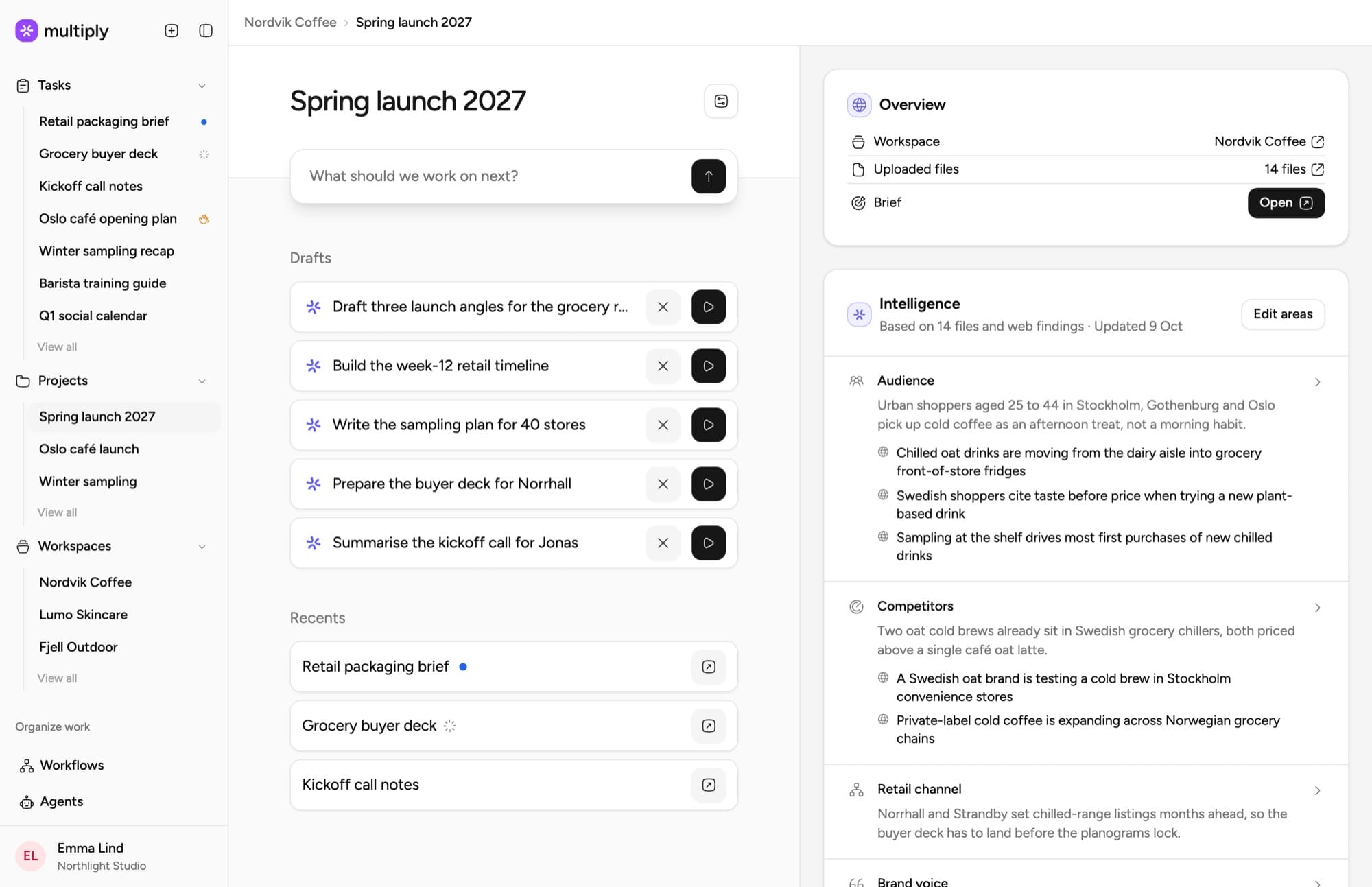
What it sounds like in their own words
“It has already had a profound effect on not only the efficiency but the efficacy of our work at Manifest.”

 Hybrid × MultiplyA short film on what changed when Hybrid put Multiply to work
HybridPR & communications network, Stockholm0:30 “I was able to execute a short proposal in around 30 minutes… I shared a first draft with the team and they had no notes.”

“I find that it's much better than ChatGPT. The answers are deeper and more professional.”

“That's the beauty of Multiply - being able to say what the researcher, strategist, and copywriter agents think. I think Multiply is quite useful, especially for strategists.”

“Working with Multiply has changed how we gain knowledge and insights into our clients’ markets.”

“Multiply helps us quickly identify which customers to prioritise and why. This has saved me hours of research time…”

“The platform automatically uses the relevant agents, which makes our life quite easy.”

How this works in practice
Still not sure which of these fits? Book a walkthrough and bring a live project.
No — that is the point of the modular design. Agencies build agents and workflows that match their own process rather than adopting someone else's. If you want the underlying idea, agency operations is the half of the problem Multiply takes on: collecting what a project knows and organising it so both people and agents can use it.
Whichever job currently eats the most non-billable time — usually research or pitch preparation. Teams that start with a job where the work is genuinely retrieval see the difference immediately; teams that start with a job requiring original judgement tend to conclude the tool does not help.
The difference is context and continuity. A general chat assistant starts from nothing every time; Multiply works from what the project already contains, keeps the sources attached, and can run the same job again next week without being re-briefed. See the product for how that is put together.
It stays yours. No training on your data, GDPR compliant, EU data residency. The detail is on the security page.
Start with the job that wastes the most time
Bring one real project to a walkthrough and we will run it against the use case you care about.