
Client reporting
Client reporting is non-billable, unavoidable and almost always late, because it competes with the delivery work in front of it. Multiply assembles reports from the project’s own material on a schedule, exports them with sources attached, and — because the reporting agent is shared rather than personal — makes the output look the same whoever produced it.
Everybody’s report looks different
Reporting is usually rebuilt each time by whoever has capacity, from whatever they can find. The consequence is not only the hours: it is that quality varies by author, and a client notices. Standardising it across the agency is a priority every operations lead recognises and few have a mechanism for, because the standard lives in a template nobody is obliged to open.
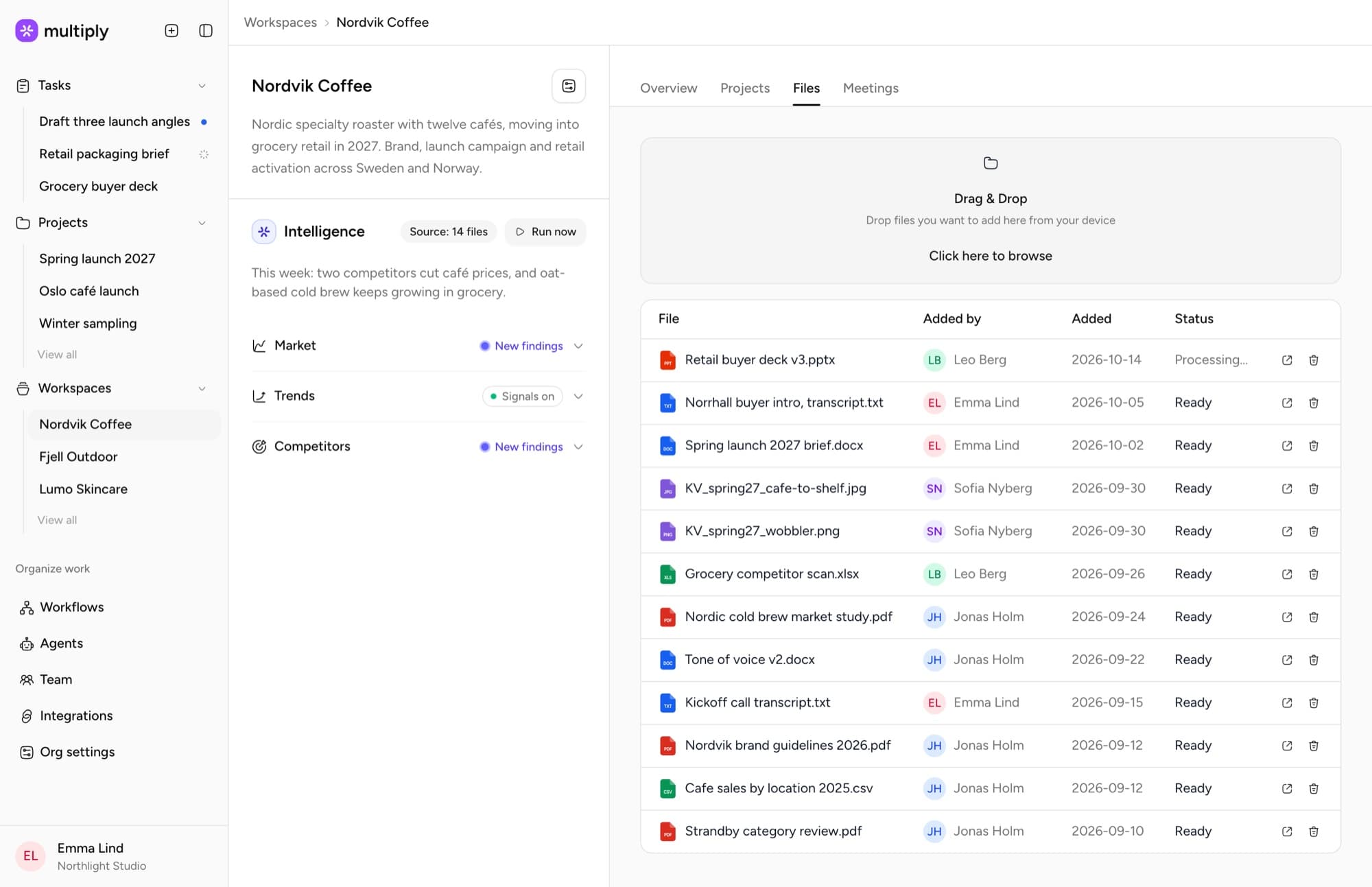
The second safety net
The value teams describe is not only speed — it is having something check the work before a client sees it, and having the agency’s standard applied without anyone having to enforce it. A shared agent is a lighter mechanism than a review process, and it survives the week everyone is busy.
The metrics these reports keep needing are covered by the free calculators, and defined in the glossary — worth linking your clients to rather than re-explaining each quarter.
Related: the product for how the pieces fit together, multi-client operations for running several of these at once, agency operations for the underlying idea, and the other use cases if reporting is not the job you want to start with.
What agencies say
“It has already had a profound effect on not only the efficiency but the efficacy of our work at Manifest.”

 Hybrid × MultiplyA short film on what changed when Hybrid put Multiply to work
HybridPR & communications network, Stockholm0:30 “I was able to execute a short proposal in around 30 minutes… I shared a first draft with the team and they had no notes.”

“I find that it's much better than ChatGPT. The answers are deeper and more professional.”

“That's the beauty of Multiply - being able to say what the researcher, strategist, and copywriter agents think. I think Multiply is quite useful, especially for strategists.”

“Working with Multiply has changed how we gain knowledge and insights into our clients’ markets.”

“Multiply helps us quickly identify which customers to prioritise and why. This has saved me hours of research time…”

“The platform automatically uses the relevant agents, which makes our life quite easy.”

Common questions
Bring last month’s report for one client. Rebuilding it live is the clearest comparison.
It works from the material and sources connected to the project — file uploads, connected sources, and custom integrations built on the REST scaffold. What is connected in your setup is a specific question worth asking on a call; see the product.
Yes — an agent per format, or one agent with client-specific instructions on the workspace. Both patterns are in use.
That is your call, and it is a real commercial question rather than a technical one. Agency teams have told us bluntly that surfacing the AI layer changes what a client thinks the work is worth. There is no client-facing portal here; deliverables leave as documents, the way they do now.
Bring last month’s report
We will rebuild it from the project’s own material and you can compare.