
Research and insight gathering
Research is the first job agency teams hand to Multiply, because it is the job where most of the hours are retrieval rather than judgement. Multiply collects the market picture, category context and competitor moves against a specific brief instead of as a generic feed, works from the files the project already contains, and keeps every source attached so the output can go into a client deliverable.
The work before the work
A strategist opens a new project and starts from nothing: hunting the category report, re-reading a brand book someone else wrote, checking what competitors have shipped since the last time anyone looked. None of that is the thinking the client is paying for, and none of it survives the project — the next brief for the same client starts the hunt again. Clients often send more material than the assignment needs, so the first real task is filtering rather than finding.
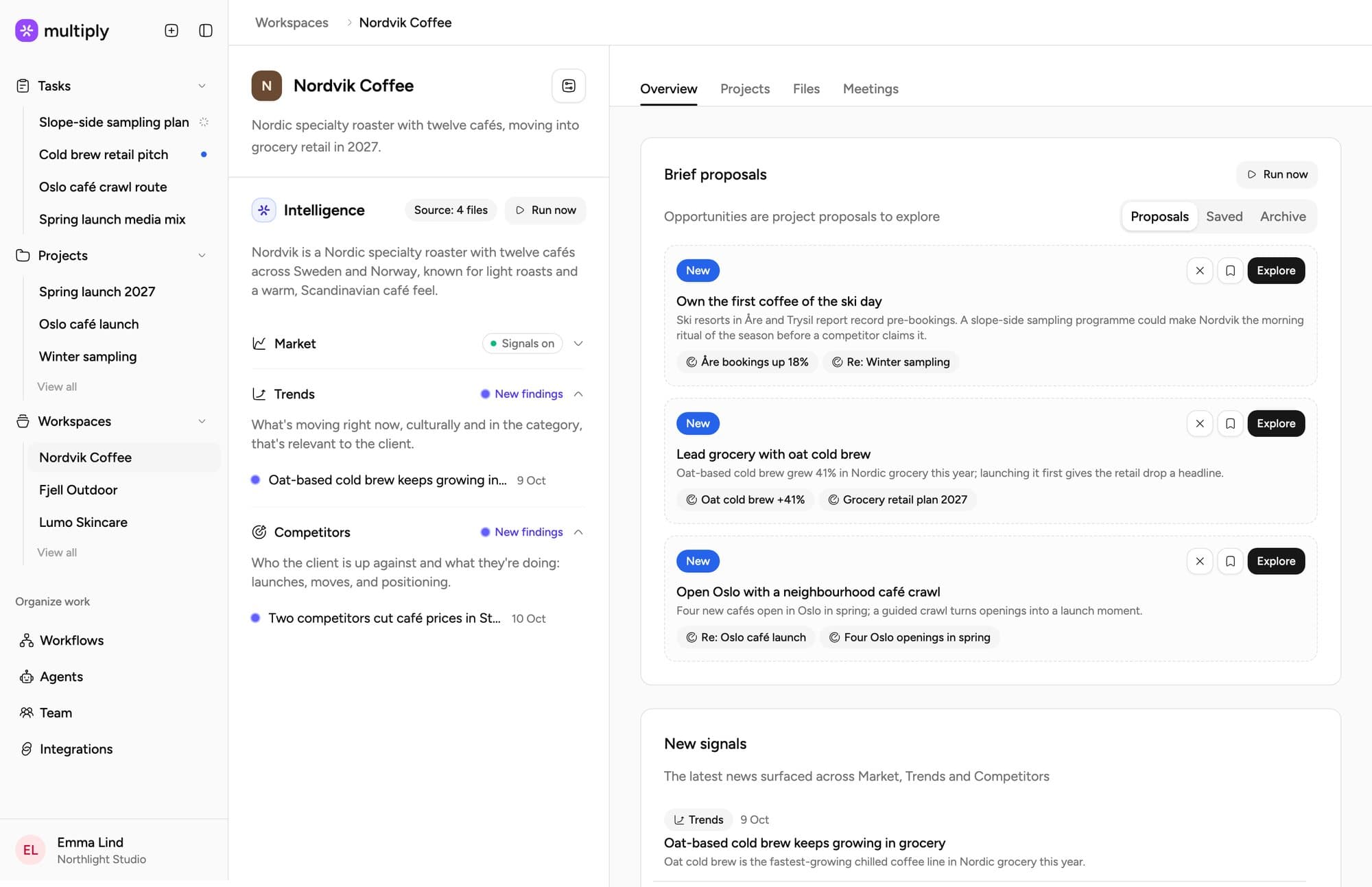
From a pile of files to a defensible picture
Multiply proposes, your team decides. Nothing here removes the strategist from the loop — it removes the retrieval.
Everything the project already has goes in
Upload the brief, past decks, correspondence, category reports, whatever arrived. There is nothing to configure first: files and a prompt are the whole setup. Client-level material — brand guidelines, strategy documents, five-year plans — is set once on the client’s workspace and steers every project underneath it.
The context engine reads it across four areas
Audience, Brand, Culture and Market. Each area surfaces key findings, the gaps in what you have, and thought-starters drawn from the material rather than from the open web. Every card carries a clickable source, so a claim can be traced before anyone repeats it to a client.
Deep research goes wider where the gaps are
The gaps are the useful output. Point deep research at them and it runs parallel research on the specific question rather than the whole topic, and comes back with citations you can check.
It exports with the sources intact
PDF and DOCX export carries the citation numbering through, which is the difference between research a client can act on and research they have to take on trust.
Every claim, with its source attached.
Open the source rather than take the summary on trust, and see how each insight was derived before it goes anywhere near a client.
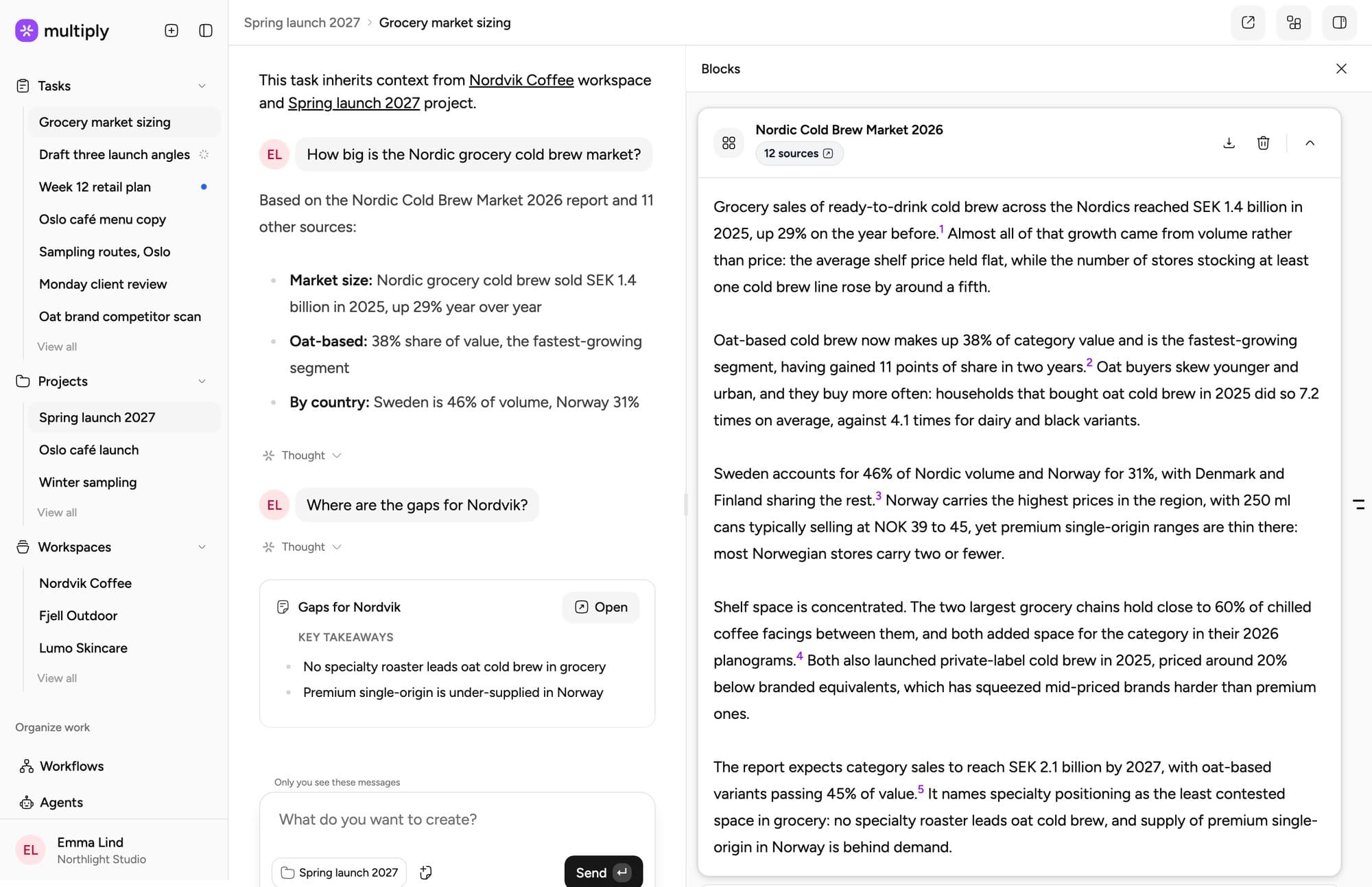
Nordic Cold Brew Market 2026
Grocery cold brew sales reached SEK 1.4 billion in 2025, up 29% year over year, with oat-based drinks the fastest-growing segment…
Where this stops being retrieval
Research is the easiest job to hand over and the easiest one to oversell. Collecting, filtering, cross-referencing and citing is retrieval, and that part genuinely compresses. Deciding which of three defensible readings of a category is the one worth building a campaign on is not retrieval, and no amount of research volume produces it.
Teams that start here see the difference immediately. Teams that start with a job requiring original judgement tend to conclude the tool does not help — which is why this is the use case we point new agencies at first.
Related: the product for how the pieces fit together, multi-client operations for running several of these at once, agency operations for the underlying idea, and the other use cases if research is not the job you want to start with.
What agencies say
“It has already had a profound effect on not only the efficiency but the efficacy of our work at Manifest.”

 Hybrid × MultiplyA short film on what changed when Hybrid put Multiply to work
HybridPR & communications network, Stockholm0:30 “I was able to execute a short proposal in around 30 minutes… I shared a first draft with the team and they had no notes.”

“I find that it's much better than ChatGPT. The answers are deeper and more professional.”

“That's the beauty of Multiply - being able to say what the researcher, strategist, and copywriter agents think. I think Multiply is quite useful, especially for strategists.”

“Working with Multiply has changed how we gain knowledge and insights into our clients’ markets.”

“Multiply helps us quickly identify which customers to prioritise and why. This has saved me hours of research time…”

“The platform automatically uses the relevant agents, which makes our life quite easy.”

Common questions
Bring a live brief to a walkthrough and we will run it against the files that project already has.
A general assistant starts from an empty box, so the person supplies the context by hand every session — and the work does not accumulate. Multiply starts from what the project and the client workspace already contain, keeps sources attached, and can run the same research again next month without being re-briefed.
The fuller comparison is on Multiply vs ChatGPT.
Every generated card links back to what it came from, and exports keep the citation numbering. That is the check: you can open the source rather than take the summary on trust. It does not make the model incapable of being wrong — it makes being wrong visible.
It stays yours. No training on your data, GDPR compliant, and each client’s material sits in its own workspace rather than a shared pool. The detail is on the security page.
Start with the research you are dreading
Bring a real brief and the files that came with it. Twenty minutes is enough to see whether the retrieval actually compresses.