
Agency knowledge and onboarding
Agency knowledge walks out of the door with people. Neither side of a client relationship keeps the same team for long, and the understanding that makes strategy and creative good is exactly what disappears when a team changes. Multiply holds client context on the workspace rather than in individuals — so a new person starts from what the agency already knows, and every project adds to it instead of resetting.
Asymmetric information, on both sides
The client’s team changes and so does the agency’s, so somebody is always the person who has to explain how this account works — and somebody is always the person who did not get the explanation. The knowledge that matters most, the accumulated sense of how a client thinks, is the least written down. Prompt libraries do not fix it: a consultant’s custom setup is a rental, and when they leave the capability leaves.
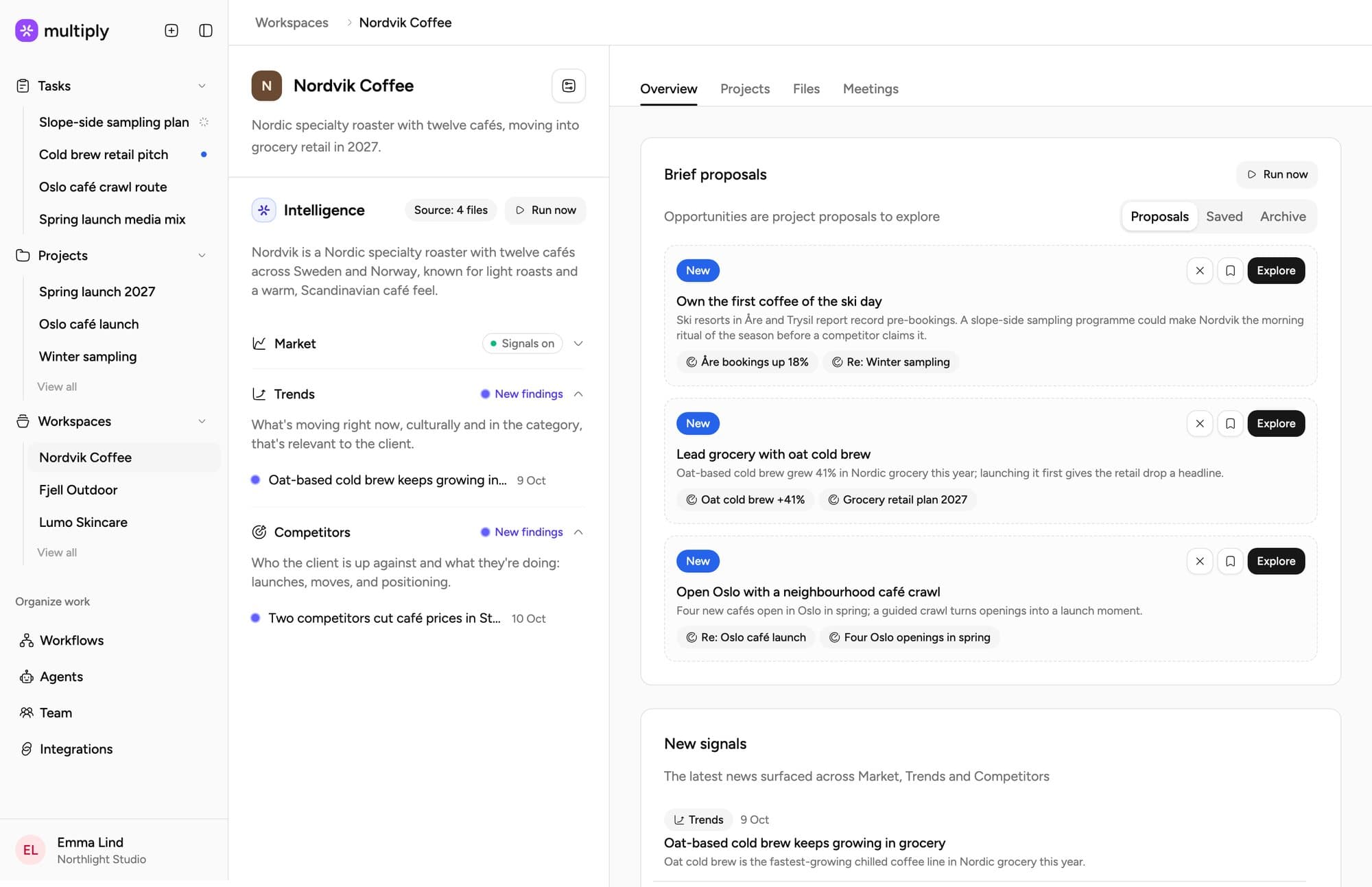
Context that belongs to the agency
Client-level context is set on the workspace
Brand guidelines, strategy documents, history and instructions live at the client level and steer every project underneath. Set once, applied by default — including agency-wide instructions set at the organisation level, so a house rule is a setting rather than a briefing.
Projects inherit, and insights flow back
A project starts with what the client workspace knows. When it closes, what was learned enriches the workspace profile — so the fifth project for a client is meaningfully better informed than the first.
Agents are the agency’s, not a consultant’s
Teams build their own agents and they are centralised: an edit propagates to everyone who uses one. That is the difference between institutional capability and someone’s clever setup.
Onboarding becomes a question rather than a handover
Someone new asks the project what the client cares about and gets an answer with sources they can read, instead of booking an hour with the one person who remembers.
Living client context. The only agency system built around it.
Every file, call and message a client sends becomes one living context. Agents read it before every task, so the work starts where your team left off.
Context flows downLearnings flow back up
Your agency
- Who you areAgency profile
- House rulesBritish English · lead with the insight
- Your team12 people, every agent
Nordvik Coffee
- BrandGuidelines, tone, assets
- Audience and marketUpdated from 14 sources
- CompetitorsWatched weekly
- Client newsLive
- Calls6 recorded, all searchable
- Brief proposals3 this week
Spring launch 2027
- BriefApproved by Jonas
- PlanWeek 12 retail drop
- FilesKey visuals, research
Draft three launch angles
- Reads everything aboveHouse rules, the Nordvik brand and market, the spring brief
- SharedEmma, Leo and the Planner work from the same picture
The compounding claim, stated carefully
For an established client where the team has been stable, the cold-start gap is already small and this use case will feel less dramatic. It earns its keep at the transitions — a new hire, a departure, an account moving between teams, a client-side reorganisation — and in the aggregate, where a hundred projects’ worth of accumulated context is a genuine asset rather than a hundred fresh starts.
This is the half of the problem agency operations describes, and multi-client operations covers holding many of these apart at once.
Related: the product for how the pieces fit together, multi-client operations for running several of these at once, agency operations for the underlying idea, and the other use cases if knowledge is not the job you want to start with.
What agencies say
“It has already had a profound effect on not only the efficiency but the efficacy of our work at Manifest.”

 Hybrid × MultiplyA short film on what changed when Hybrid put Multiply to work
HybridPR & communications network, Stockholm0:30 “I was able to execute a short proposal in around 30 minutes… I shared a first draft with the team and they had no notes.”

“I find that it's much better than ChatGPT. The answers are deeper and more professional.”

“That's the beauty of Multiply - being able to say what the researcher, strategist, and copywriter agents think. I think Multiply is quite useful, especially for strategists.”

“Working with Multiply has changed how we gain knowledge and insights into our clients’ markets.”

“Multiply helps us quickly identify which customers to prioritise and why. This has saved me hours of research time…”

“The platform automatically uses the relevant agents, which makes our life quite easy.”

Common questions
Bring a client you have worked with for years. That is where the accumulated context shows.
No, and that distinction matters — a knowledge base someone has to curate is a knowledge base that goes stale. Context accumulates from the work: the files a project already contains, and what it learns as it runs.
Access is managed per workspace, and context does not cross between clients. Private material — meeting recordings, personal mail — stays scoped to private work until a person chooses to share it.
Your material is yours and exports as documents. It is a fair question to ask any platform holding your client knowledge, and a fairer one to ask a consultant who built your setup inside their own account.
Pick the client whose knowledge you would most hate to lose
We will load what that account already has and show you what comes back out of it.