
New business and pitching
Pitching is the purest version of the retrieval problem: most of the hours go into assembling a picture of a prospect nobody at the agency has assembled before, and it is non-billable. Multiply builds that picture from whatever material exists, and every client workspace additionally runs a weekly job that researches news and drafts up to three pitch proposals — so proactive new business stops depending on someone finding a spare afternoon.
The most expensive non-billable hours in the agency
Pitch work pulls practitioners out of delivery and salespeople out of business development, and the output is often generic anyway — because the agency has not deeply processed the brief before writing, so the proposal replays what was in the brief. Costings and timelines usually sit in a different part of the business with different people, which is why even a basic response can take two days to assemble. The cold-start problem is at its worst here: nobody has any accumulated context on a prospect.
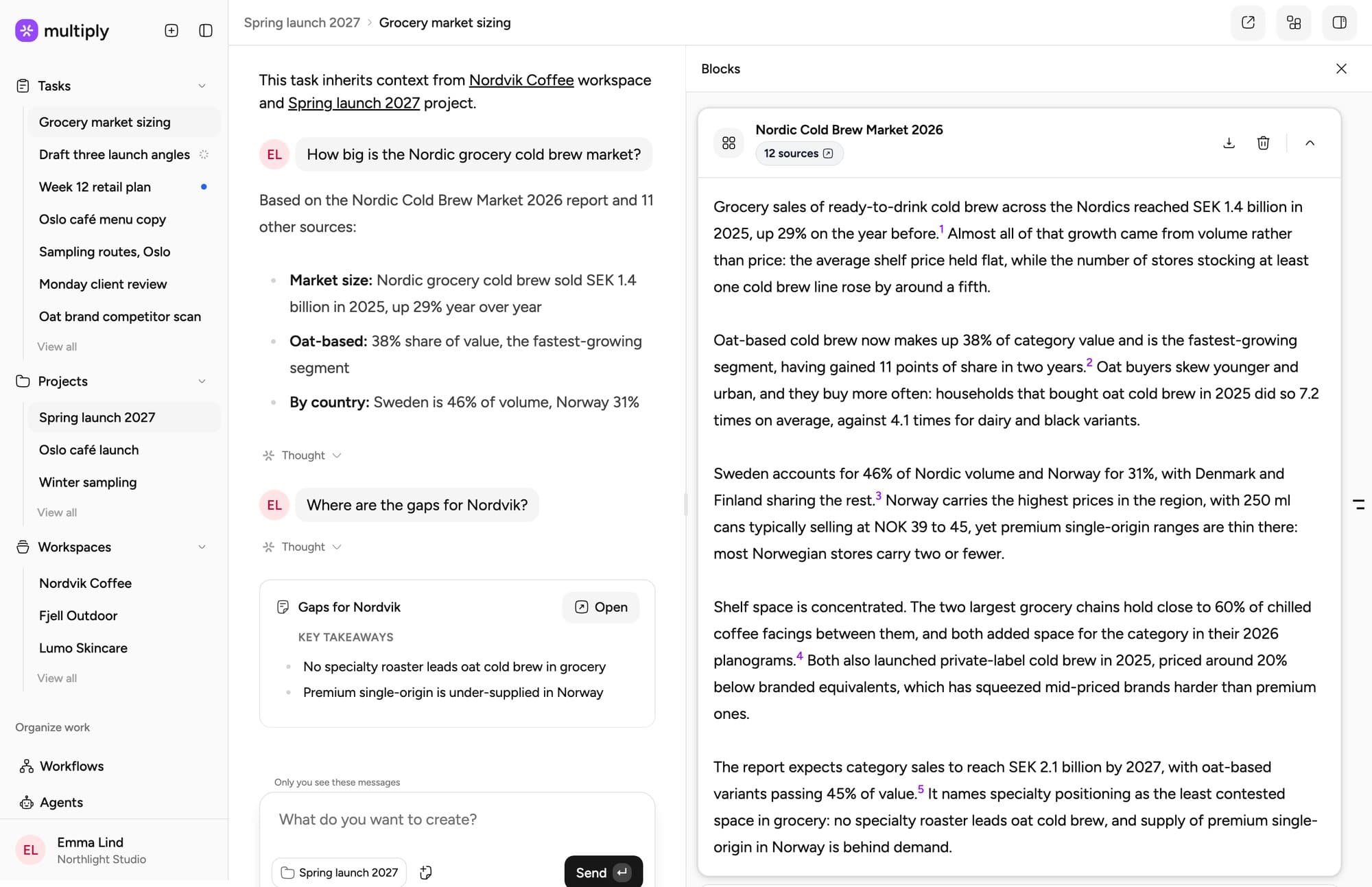
Cold start, warm by the end of the afternoon
Set up the prospect as a workspace
Everything you can find about them goes in — their published material, the RFP, the category context, your own credentials and relevant past work. Setup is a file upload and a prompt.
Get the picture, with the gaps named
Audience, brand, culture and market come back with sources attached, and the knowledge gaps tell you what to ask in the chemistry meeting rather than guess at in the deck.
Weekly proposals arrive without being asked
Each workspace runs a weekly automated job that researches news and drafts up to three pitch or brief proposals, surfaced on the workspace overview. Any one of them can be turned into a project. This is the part that changes new business from reactive to proactive.
The context survives the pitch
Win it and the workspace is already the client’s workspace, with the research and the reasoning in it. Lose it and the category work is still there for the next prospect in that category.
New business stops waiting for a spare afternoon.
A Planner that organises everything you know into insights and sources the next brief before you ask.
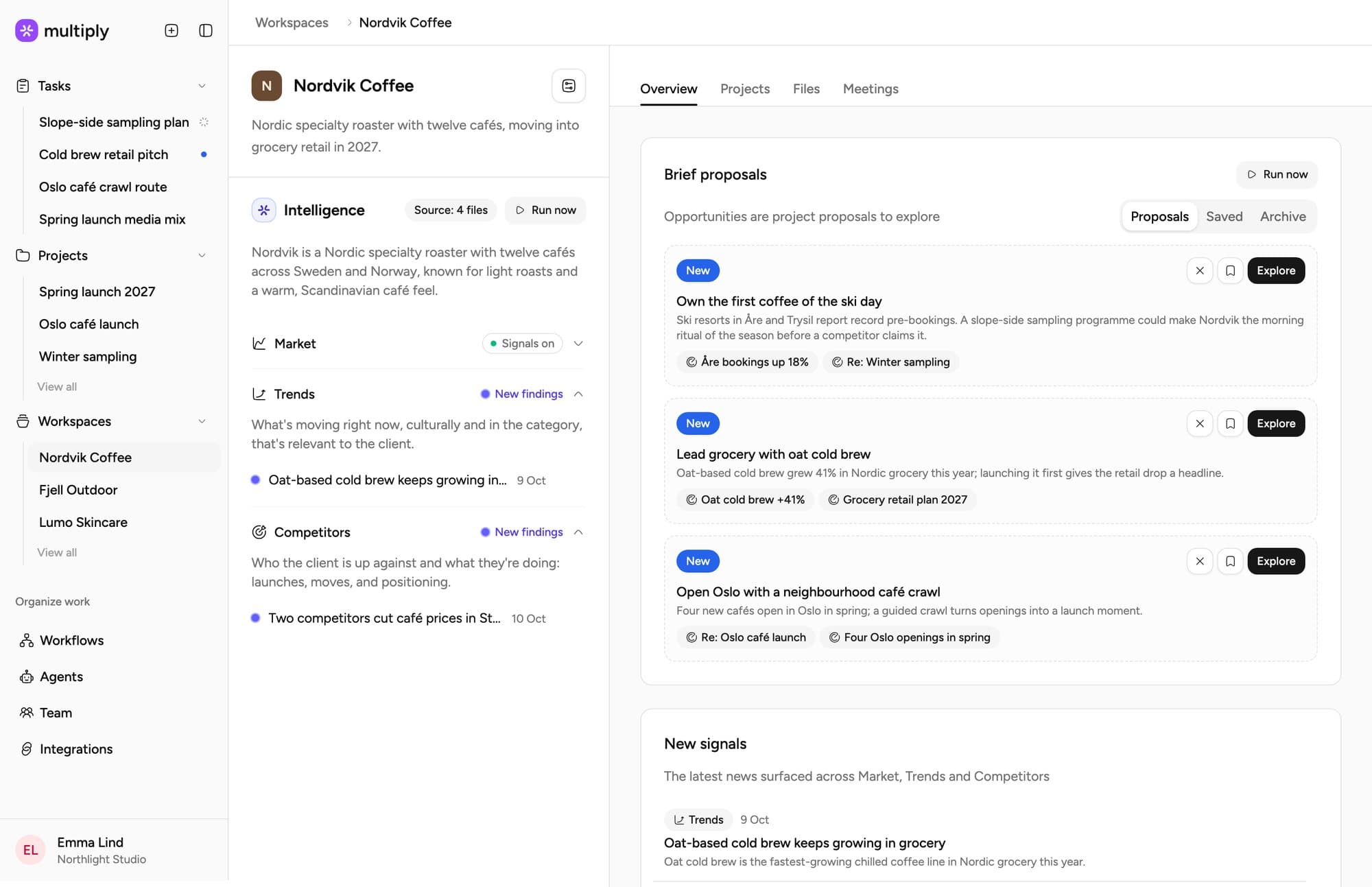
Own the first coffee of the ski day.
Nordvik's winter sales peak a month before its campaigns start. Three resorts have opened tenders for café partners.
What it does not do
It does not write the pitch. The idea, the leap and the room are yours, and an agency that outsources those has nothing left to sell. What it removes is the two days of assembly in front of the thinking, and the blank sheet of paper.
It also does not replace the costing systems that live elsewhere in the business. Timelines and rate cards still come from where they come from.
Related: the product for how the pieces fit together, multi-client operations for running several of these at once, agency operations for the underlying idea, and the other use cases if pitching is not the job you want to start with.
What agencies say
“It has already had a profound effect on not only the efficiency but the efficacy of our work at Manifest.”

 Hybrid × MultiplyA short film on what changed when Hybrid put Multiply to work
HybridPR & communications network, Stockholm0:30 “I was able to execute a short proposal in around 30 minutes… I shared a first draft with the team and they had no notes.”

“I find that it's much better than ChatGPT. The answers are deeper and more professional.”

“That's the beauty of Multiply - being able to say what the researcher, strategist, and copywriter agents think. I think Multiply is quite useful, especially for strategists.”

“Working with Multiply has changed how we gain knowledge and insights into our clients’ markets.”

“Multiply helps us quickly identify which customers to prioritise and why. This has saved me hours of research time…”

“The platform automatically uses the relevant agents, which makes our life quite easy.”

Common questions
Bring a live prospect. A pitch in flight is the fastest way to see whether this holds up.
Yes. Each workspace is its own container and context does not cross between them — which matters more than usual in pitch work, where you may be pitching against a category your existing client sits in.
A scheduled job on the workspace researches news relevant to that client or prospect and drafts up to three proposals from it. They are proposals for a person to accept, reject or reshape — not work that goes anywhere on its own.
This one, on what agencies tell us. It is also the most retrieval-heavy, which is not a coincidence. Proposals and scoping covers what happens once the pitch is won.
Bring a pitch you are working on now
We will build the prospect picture live and you can judge it against the two days you would otherwise spend.