
Proposals and scoping
Proposals and scopes of work are where agency margin is decided and where agency time is least visible. Multiply drafts from the agency’s own templates and the project’s own material — an 80% draft a person then shapes — and keeps the agreed scope reachable inside the project while the work runs, rather than in a document nobody reopens until the WIP review.
Scope tracking is a list and a good memory
Scope is usually tracked by looking at it and ticking things off. The scope lives in one place, the tracker in another, the client emails in a shared inbox. Nothing cross-references what a client has asked for against what was actually agreed, so scope creep is caught in an email chain or a WIP review rather than when it happens — and a senior person can work an account for months without having seen the original SOW, with no living reference point to self-correct against.
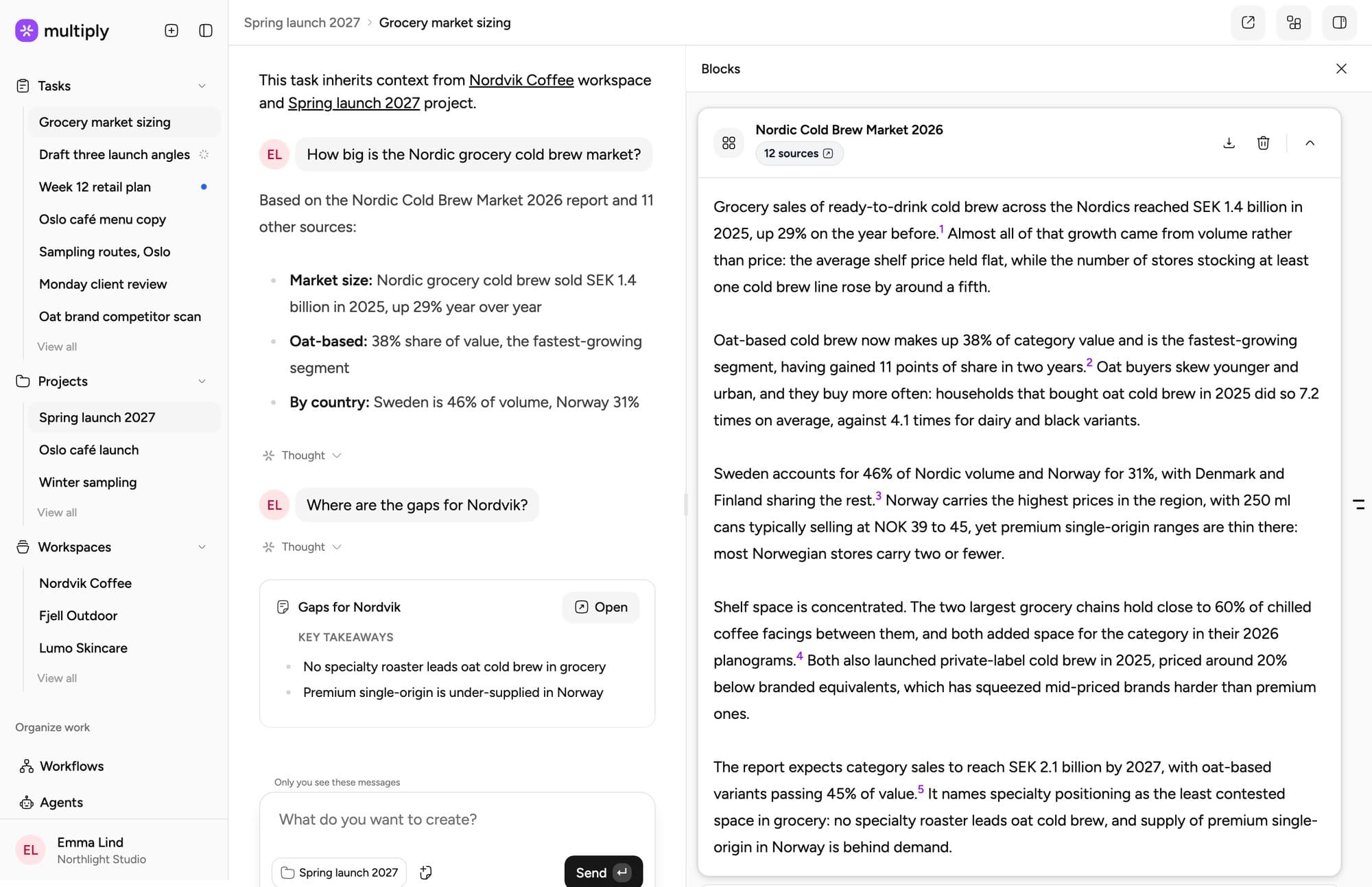
A draft to argue with, and a scope you can point at
Your templates, not ours
Upload the agency’s proposal and SOW templates as project material and build an agent around them. Agents are centralised, so when someone improves the template the improvement reaches everyone rather than living in one person’s copy.
Draft to 80%, then argue with it
The draft is a starting position built from the brief, the material and the template. It exists so a right-brained team can produce a left-brained document without waiting on a second person, and so nobody starts from a blank page.
Every plan is approved before it runs
Multiply proposes a plan as a card and waits. On work this consequential that pause is the feature, not friction — you are reading what it intends to do before it does it.
The scope stays where the work is
Once the agreed scope is project material, it is reachable from any task on that project. "What did we actually commit to" becomes a question with an answer attached to sources rather than a question for whoever has been on the account longest.
From brief to SoW, in one project.
The Project Manager drafts the brief, the plan and the statement of work inside the project. Your team shapes them before anything goes to the client.
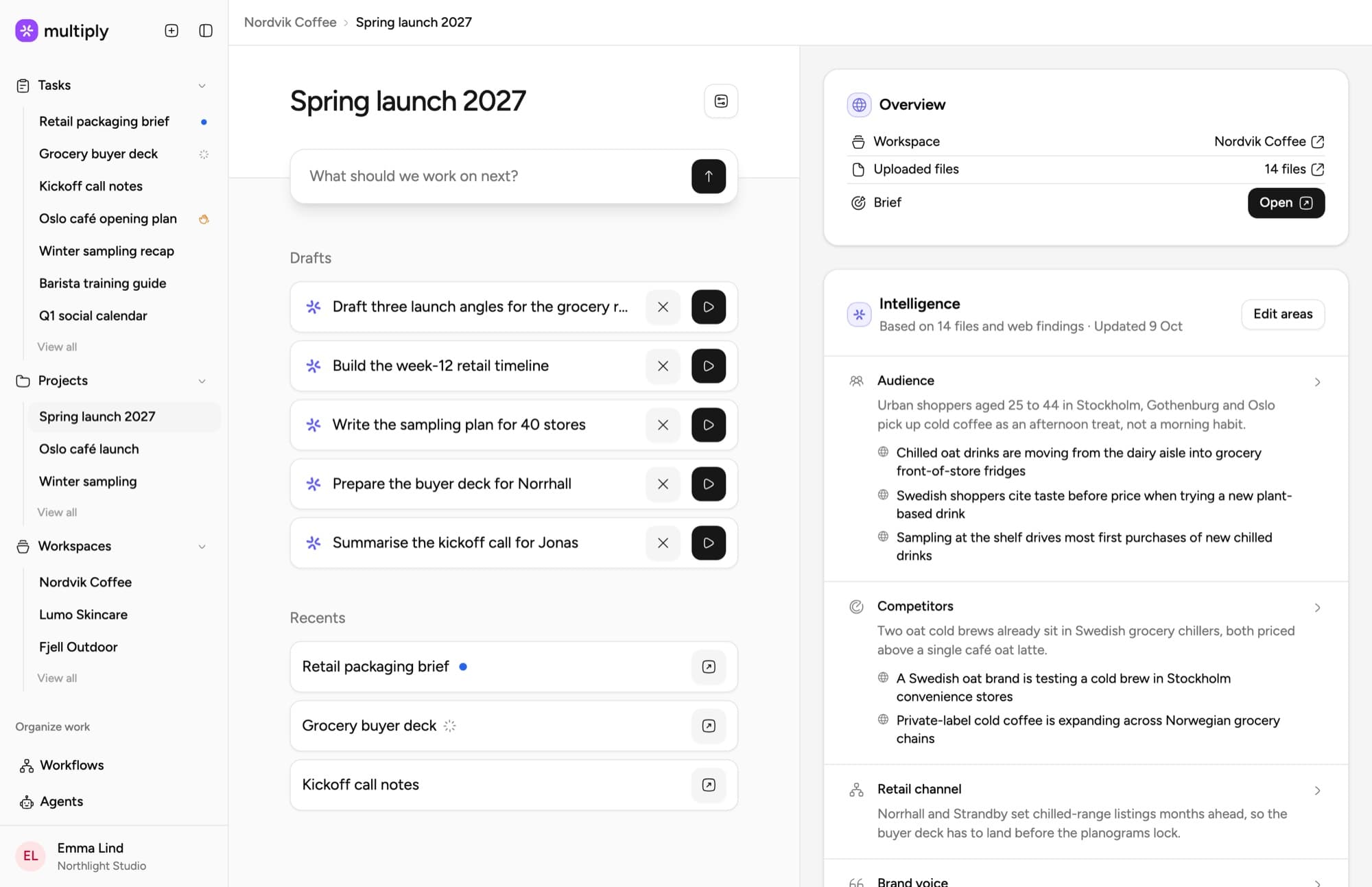
- Done: Brief drafted
- Done: Plan and timeline
- Done: Statement of work
- To do: Kickoff, Tuesday 10:00
An agency sells units of time, and cannot see its inventory
That is the real problem underneath scoping, and it is a genuinely hard one. A supermarket can count its stock; an agency selling hours at scale largely cannot. Nothing here solves that on its own.
What it does is remove the two reasons the scope stops being consulted: it was somewhere else, and keeping it current was somebody’s manual job. When the brief, the scope and the work sit in one place, the barrier to keeping it updated drops — and a defensible record replaces a judgement call when an account lead needs something concrete to show a client.
Related: the product for how the pieces fit together, multi-client operations for running several of these at once, agency operations for the underlying idea, and the other use cases if scoping is not the job you want to start with.
What agencies say
“It has already had a profound effect on not only the efficiency but the efficacy of our work at Manifest.”

 Hybrid × MultiplyA short film on what changed when Hybrid put Multiply to work
HybridPR & communications network, Stockholm0:30 “I was able to execute a short proposal in around 30 minutes… I shared a first draft with the team and they had no notes.”

“I find that it's much better than ChatGPT. The answers are deeper and more professional.”

“That's the beauty of Multiply - being able to say what the researcher, strategist, and copywriter agents think. I think Multiply is quite useful, especially for strategists.”

“Working with Multiply has changed how we gain knowledge and insights into our clients’ markets.”

“Multiply helps us quickly identify which customers to prioritise and why. This has saved me hours of research time…”

“The platform automatically uses the relevant agents, which makes our life quite easy.”

Common questions
Bring a scope you are about to write. Or one that went wrong — those are more instructive.
It uses what you give it. Rate cards, templates and past proposals uploaded as material are what the draft is built from — and if your costings live in a separate system, that stays true. This drafts the document, it does not replace your finance stack.
Not as an alarm. What it gives you is the agreed scope held as project context, so the comparison is possible at all — including as a recurring workflow that reports on it. Treat the human review as the decision point.
No. There is no client portal, deliberately — agency teams told us plainly that clients will not log into one, and that showing a client the AI layer changes what they think the work is worth. Deliverables leave as PDF or DOCX with sources, the way they do today.
Bring a real SOW and your template
We will draft against them live so you can judge the 80% for yourself.