
PR and communications
PR work is dense with jobs that are almost entirely retrieval — spokesperson matrices, media training preparation, coverage analysis, award entries — and unusually sensitive to confidentiality, because a great deal of it is embargoed. Multiply runs those jobs against the client’s own workspace, with no training on your data and each client’s material held separately.
High volume, high sensitivity, low tolerance for leaks
A comms team assembles the same categories of document repeatedly — who speaks to what, what a journalist has written before, what the coverage adds up to, what an award entry has to prove. Most of that is assembly. But it is assembly over material that frequently cannot leave a jurisdiction or become public early, which is why ad-hoc assistant use so rarely survives a security review, and why security carries veto power over tool choice in this discipline specifically.
The jobs comms teams hand over first
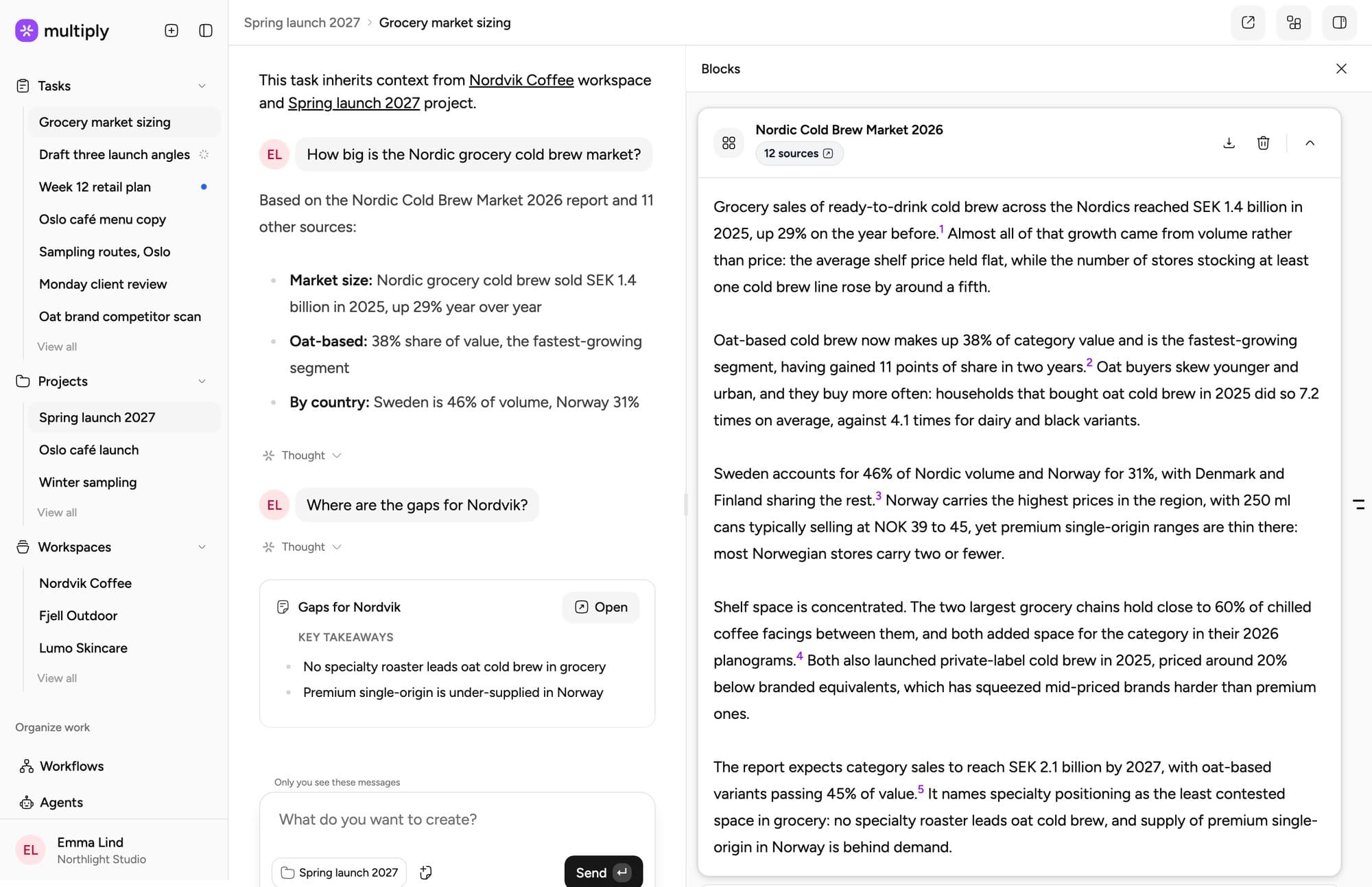
Spokesperson matrices and media prep
Built from the client’s own material plus the category picture — who should speak to which topic, what they have said before, and what a journalist covering it has previously written.
Coverage analysis with the sources attached
Analysis a client can check rather than take on trust, exported as PDF or DOCX with citation numbering intact.
Award entries against the evidence
Award writing is largely the retrieval of proof: what happened, what moved, what the client said at the time. When the project holds that material, the entry stops being an archaeology exercise.
Thought leadership as an agent, not a one-off
Teams build a thought-leadership agent tuned to a spokesperson’s voice and remit and reuse it. Because agents are centralised, an improvement one consultant makes reaches the whole team.

Your clients' work stays yours.
Agencies trust Multiply with their clients' most sensitive work. Here is how it stays protected.
- EU data residencyYour data is stored and processed in the EU.
- No training on your dataNo AI model is trained on anything you bring.
- One workspace per clientAgents only see the client they're working for.
Where the confidentiality line sits
Embargoed and private material is the reason this discipline evaluates tools differently. Each client sits in its own workspace and context does not cross between them. Private sources — meeting recordings and personal mail among them — stay scoped to private work rather than flowing into a shared client context, and nothing you put in trains a model.
GDPR compliant, ISO 27001 in progress, and the full posture is on the security page. If your review process has a questionnaire, send it — that is a faster route than a demo.
Related: the product for how the pieces fit together, multi-client operations for running several of these at once, agency operations for the underlying idea, and the other use cases if PR work is not the job you want to start with.
What agencies say
“It has already had a profound effect on not only the efficiency but the efficacy of our work at Manifest.”

 Hybrid × MultiplyA short film on what changed when Hybrid put Multiply to work
HybridPR & communications network, Stockholm0:30 “I was able to execute a short proposal in around 30 minutes… I shared a first draft with the team and they had no notes.”

“I find that it's much better than ChatGPT. The answers are deeper and more professional.”

“That's the beauty of Multiply - being able to say what the researcher, strategist, and copywriter agents think. I think Multiply is quite useful, especially for strategists.”

“Working with Multiply has changed how we gain knowledge and insights into our clients’ markets.”

“Multiply helps us quickly identify which customers to prioritise and why. This has saved me hours of research time…”

“The platform automatically uses the relevant agents, which makes our life quite easy.”

Common questions
Bring a live account, or your security questionnaire. Both are useful first steps.
That is what workspace separation and the no-training commitment are for, and it is the question this discipline asks first. Read the security page, then send us your security questionnaire — we would rather answer it before you trial than after.
No. If you run one, its exports are useful material to feed in. This handles the assembly and analysis around it rather than the contact data itself.
Meeting recordings can be brought in, and they stay private by default rather than being ingested into a shared client context automatically. Deciding what becomes shared context is a person’s call.
Bring the account with the tightest confidentiality
If it works there it works everywhere else in the agency. Send the security questionnaire ahead of the call.