
Market and competitor monitoring
Monitoring a client’s category is work every agency agrees is valuable and almost none does consistently, because it only happens when someone has a spare hour. Multiply runs it as a scheduled workflow per client — daily, weekly or monthly — gathering signals against that client’s context and reporting back, so the scan happens whether or not anyone had time for it.
The most valuable thing that never gets done
The trigger for wanting category intelligence is almost never a fixed point in the calendar — it is mid-project, when someone realises a relevant report exists and they could send it to the client. That is exactly the kind of work that loses to the deadline in front of it. So it happens in bursts before a quarterly review, which is the opposite of monitoring.
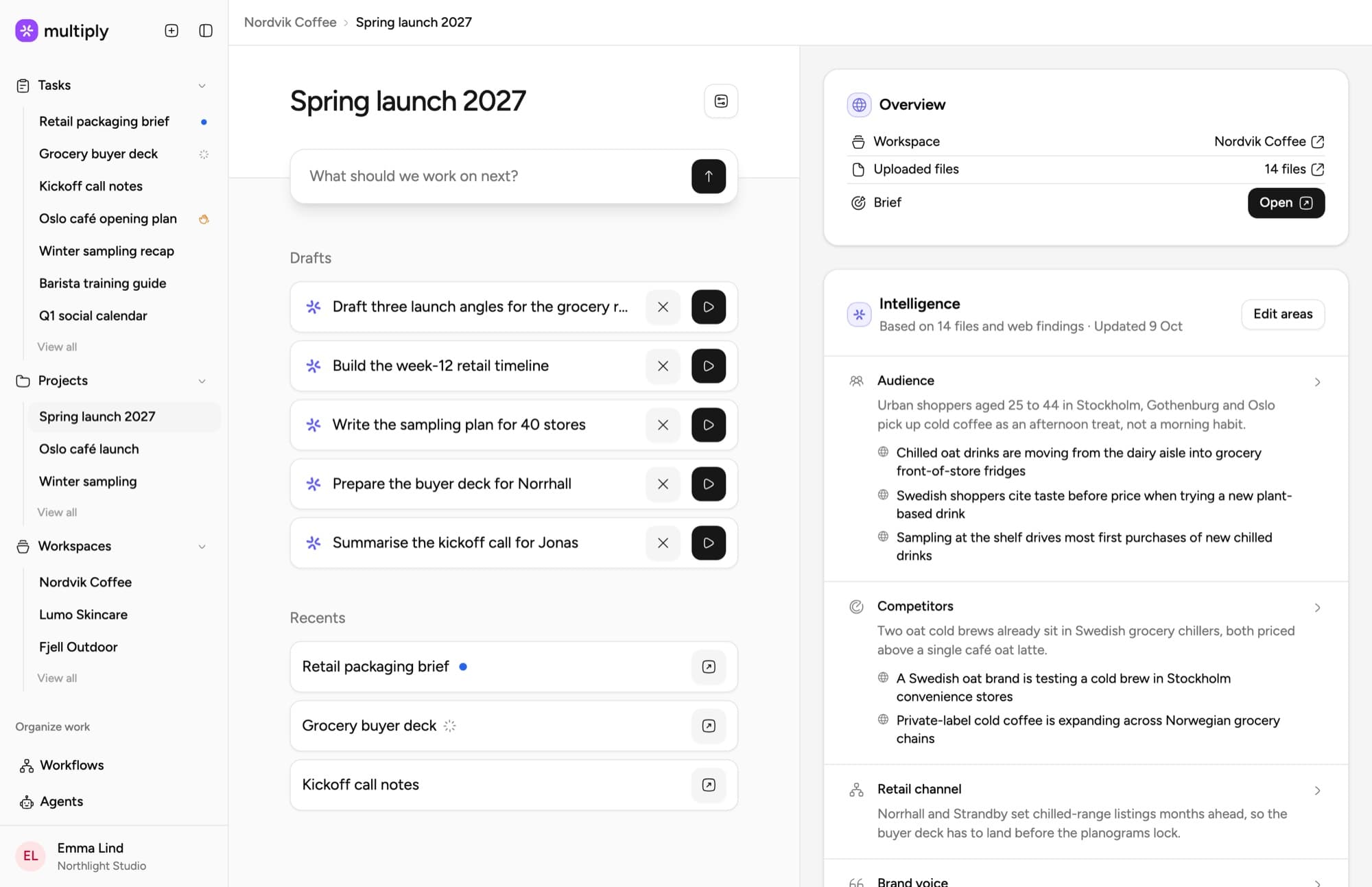
Set it once, and stop remembering to do it
Write the instruction in plain language
Describe what you want watched and how often. A workflow is a scheduled recurring agent run — daily, weekly or monthly — using the same agents and tools as any other task.
Point it at a client, not at the world
A workflow connects to a specific workspace or project, so it monitors against that client’s brand, category and history rather than returning a generic industry feed. This is the difference between a signal and a newsletter.
It reports back like any other work
Output lands as a task on the project, with sources, so it can be read, forwarded or exported. Runs are autonomous — they do not sit waiting for someone to click approve — and if a run genuinely cannot proceed it asks a clarifying question instead of stalling silently.
The findings accumulate
Each run adds to what the workspace knows about that client’s category, so month six is better informed than month one rather than the same scan repeated.
The scan happens whether or not anyone had time.
Not a dashboard of mentions. An answer to the question you wrote, in the context of one client, handed back as something readable with its sources.
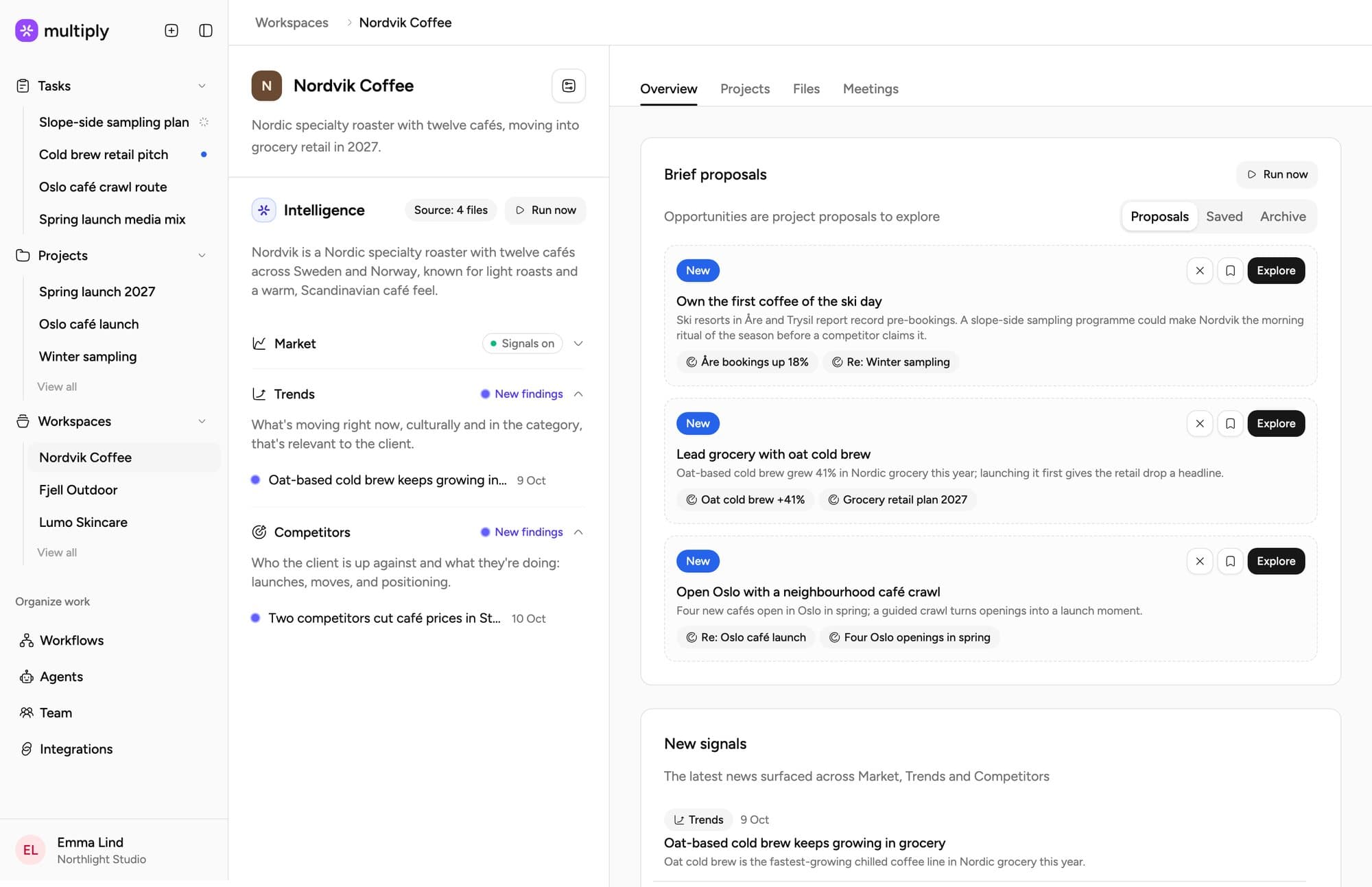
Four launches in the last 30 days.
Two price cuts in Stockholm cafés and a new oat range in grocery, led by the market's two largest chains.
The failure mode to avoid
A monitoring workflow that reports everything gets muted in a fortnight, and a muted workflow is worse than none because it still costs something to run. Write the instruction around what would actually change a decision — a competitor’s positioning moving, a regulatory shift, a category narrative turning — rather than around coverage volume.
For the metrics teams keep asking these reports to compute, the free calculators cover share of voice, engagement rate and the rest, and the glossary defines them.
Related: the product for how the pieces fit together, multi-client operations for running several of these at once, agency operations for the underlying idea, and the other use cases if monitoring is not the job you want to start with.
What agencies say
“It has already had a profound effect on not only the efficiency but the efficacy of our work at Manifest.”

 Hybrid × MultiplyA short film on what changed when Hybrid put Multiply to work
HybridPR & communications network, Stockholm0:30 “I was able to execute a short proposal in around 30 minutes… I shared a first draft with the team and they had no notes.”

“I find that it's much better than ChatGPT. The answers are deeper and more professional.”

“That's the beauty of Multiply - being able to say what the researcher, strategist, and copywriter agents think. I think Multiply is quite useful, especially for strategists.”

“Working with Multiply has changed how we gain knowledge and insights into our clients’ markets.”

“Multiply helps us quickly identify which customers to prioritise and why. This has saved me hours of research time…”

“The platform automatically uses the relevant agents, which makes our life quite easy.”

Common questions
We will write the first workflow with you on the walkthrough, against a real client.
A listening tool is built to measure mentions and hand you a dashboard. This is built to answer a question you wrote, in the context of one client, and hand back something readable with sources. They are not mutually exclusive — several agencies run both, and feed the listening tool’s output in as material.
That is the normal setup: one workflow per client, connected to that client’s workspace. It was an agency request — monitoring world events per client — that shaped how workspace-level workflows work.
Weekly, for one client, for a month. Daily is usually noise unless the category genuinely moves daily, and a single client is enough to find out whether the instruction was written well before it is copied across the roster.
Pick one client and one question
A single well-written weekly workflow tells you more about whether this fits than a demo of ten.