
A Waldo alternative for running the work, not only researching it
Waldo is an agency-focused AI platform with direct overlap on the research and intelligence side. Agencies weighing it against Multiply are usually deciding between two different jobs: gathering better market, competitor and audience intelligence, or running the client operation the intelligence feeds — briefing, delivery, recurring account work and many clients held apart. The two are compatible, and several agencies use intelligence output as material inside an operating system.
Strong on the intelligence half
Waldo is built for agency and strategist workflows and is genuinely good at the collection problem — pulling category and audience signal into something a strategist can use. Our own competitive notes say plainly that Waldo needs more primary research on our side than Springboards does, and we would rather write that than pretend to a certainty we do not have.
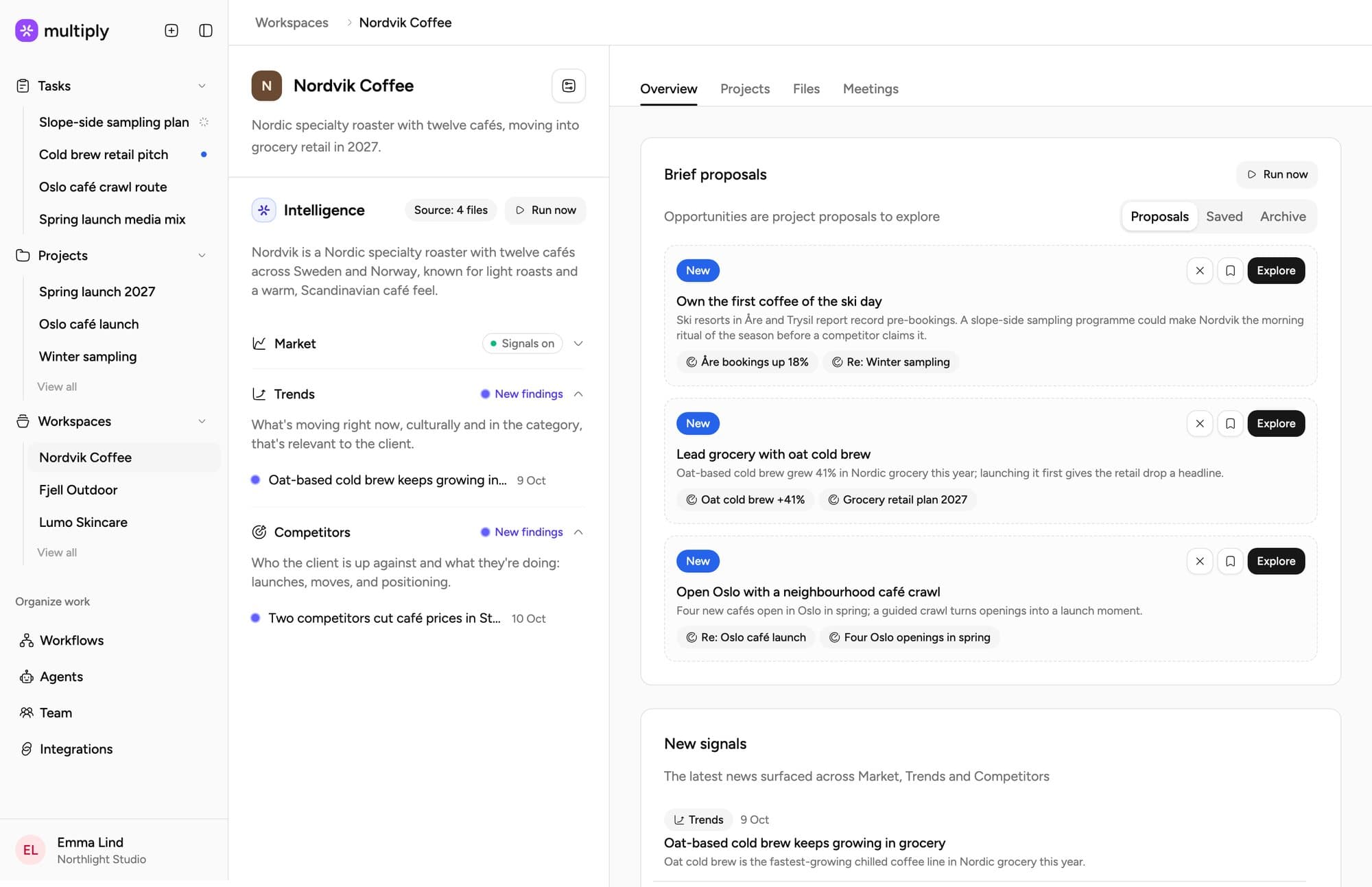
Side by side
The last row is the one to notice. These are more complementary than the shared category label suggests, and several agencies run both rather than choosing.
| Waldo | Multiply | |
|---|---|---|
| Primary job | YesGathering intelligence | YesRunning the client operation the intelligence feeds |
| Agency-focused | Yes | Yes |
| Where research ends up | PartlyIn the tool | YesIn a brief, a proposal or a deliverable, with sources |
| Client architecture | Partly | YesOrg, workspace, project, task — context inherits |
| Your process, encoded | NoNot its shape | YesAgents your agency builds and owns |
| Compatible with the other | YesYes — output is good material | YesYes — uploads inherit client context |
Where it actually shows up in agency work
Feature grids tend to agree with each other. These are the places the categories genuinely diverge.
Client architecture underneath
Organisation, client workspace, project and task, with context inheriting downward. That is what makes twenty concurrent clients an operation rather than twenty parallel research efforts.
Your process, encoded as your agents
Agencies build and own agents shaped to their own frameworks, centralised so improvements spread. Intelligence tools give you a better feed; this gives you a better operation.
The recurring work, on a schedule
Scheduled workflows per client, and reporting that goes out because it was scheduled rather than because someone found the time.
Research is an input, not the deliverable
Intelligence has to land in a brief, a deck or a proposal to be worth anything. Multiply is built around that arc — research into briefing into delivery — rather than around the collection step.
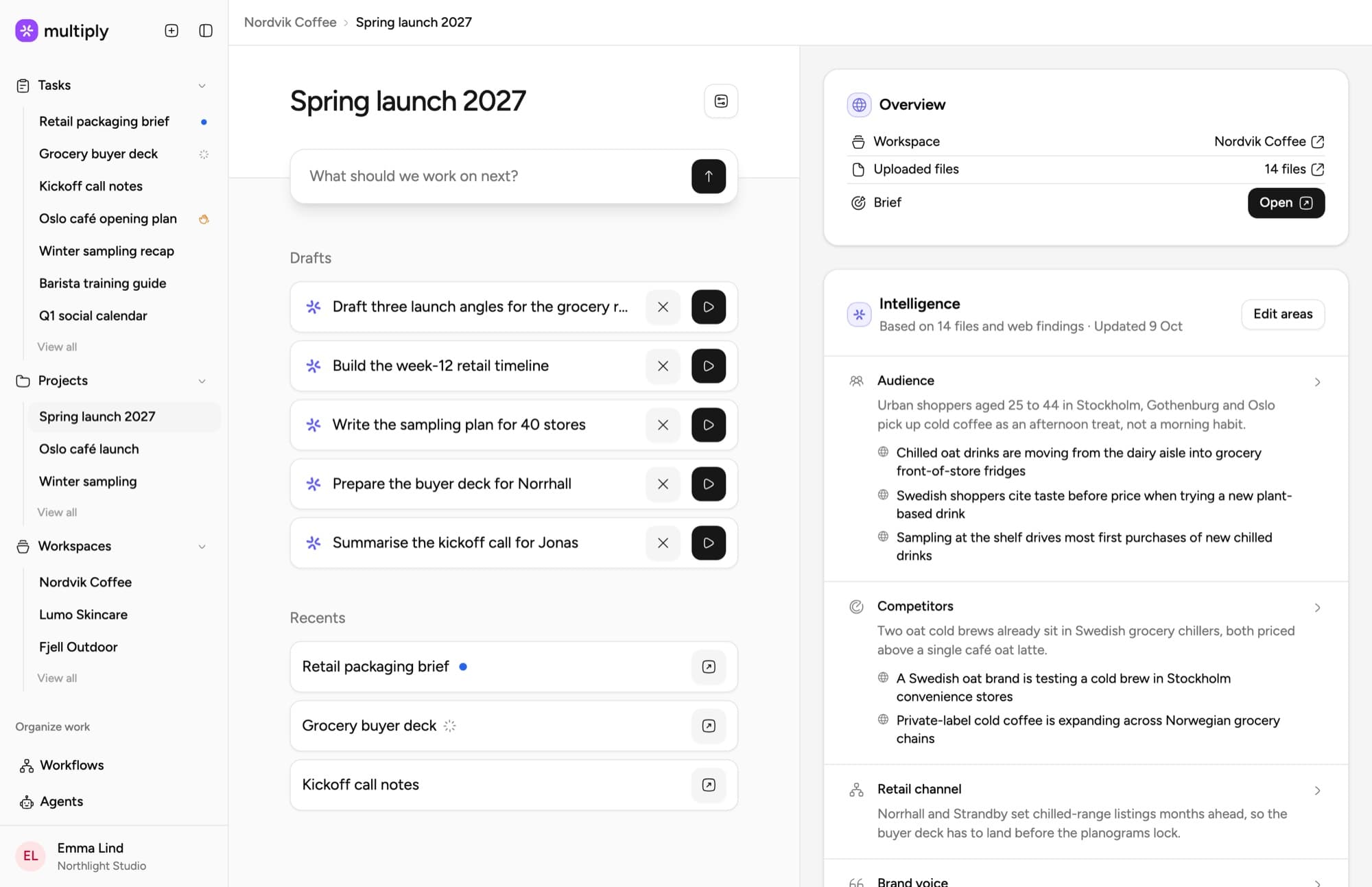
- Done: Brief drafted
- Done: Plan and timeline
- Done: Statement of work
- To do: Kickoff, Tuesday 10:00
When Waldo is the right answer
If the gap is specifically intelligence — you need more and better signal on categories, competitors and audiences, and the operation around it is working — then an intelligence platform is the more direct fix, and an operating system is a large purchase for a narrow problem.
Running both is a legitimate answer too: intelligence output is good material to bring into a project, where it inherits the client context and ends up in the deliverable.
Where to look next
Market and competitor monitoring is the use case that overlaps most directly, and the buyer's guide places both in the agency-native group.
Common questions
Bring the question you most want answered about a client’s category, and the deliverable it has to end up in.
Yes, and it is a reasonable setup. Intelligence output uploaded as project material inherits the client context and flows into what you actually deliver.
Not as a dedicated listening product. Multiply monitors against a client’s context on a schedule and reports back with sources. If you need mention-level measurement, a listening tool does that better and its exports are useful input here.
Ask what a good week looks like. If it is "we saw the signal early", that is an intelligence problem. If it is "the work went out on time and looked like us", that is an operations problem.
Ask what a good week looks like
The answer usually tells you which of the two you need. Bring a live account either way.