
A Springboards alternative that covers more than ideation
Springboards is the closest thing to a direct competitor Multiply has: purpose-built for agencies and strategists, co-founded by ex-agency strategists Pip Bingemann and Amy Tucker, backed by more than 120 agencies and a $5M seed from Blackbird Ventures. It is weighted towards generating better ideas. Agencies looking for an alternative are usually looking for something that covers research through delivery, holds many clients apart, and runs recurring work — rather than something that ideates better.
Built by agency people, and it shows
Springboards has genuine agency credibility, distribution through the agency network itself, and a clear thesis: agencies want better ideas rather than faster answers. That is a defensible position and it is not the same position as ours. If your bottleneck really is idea generation, take it seriously — it is built for exactly that.
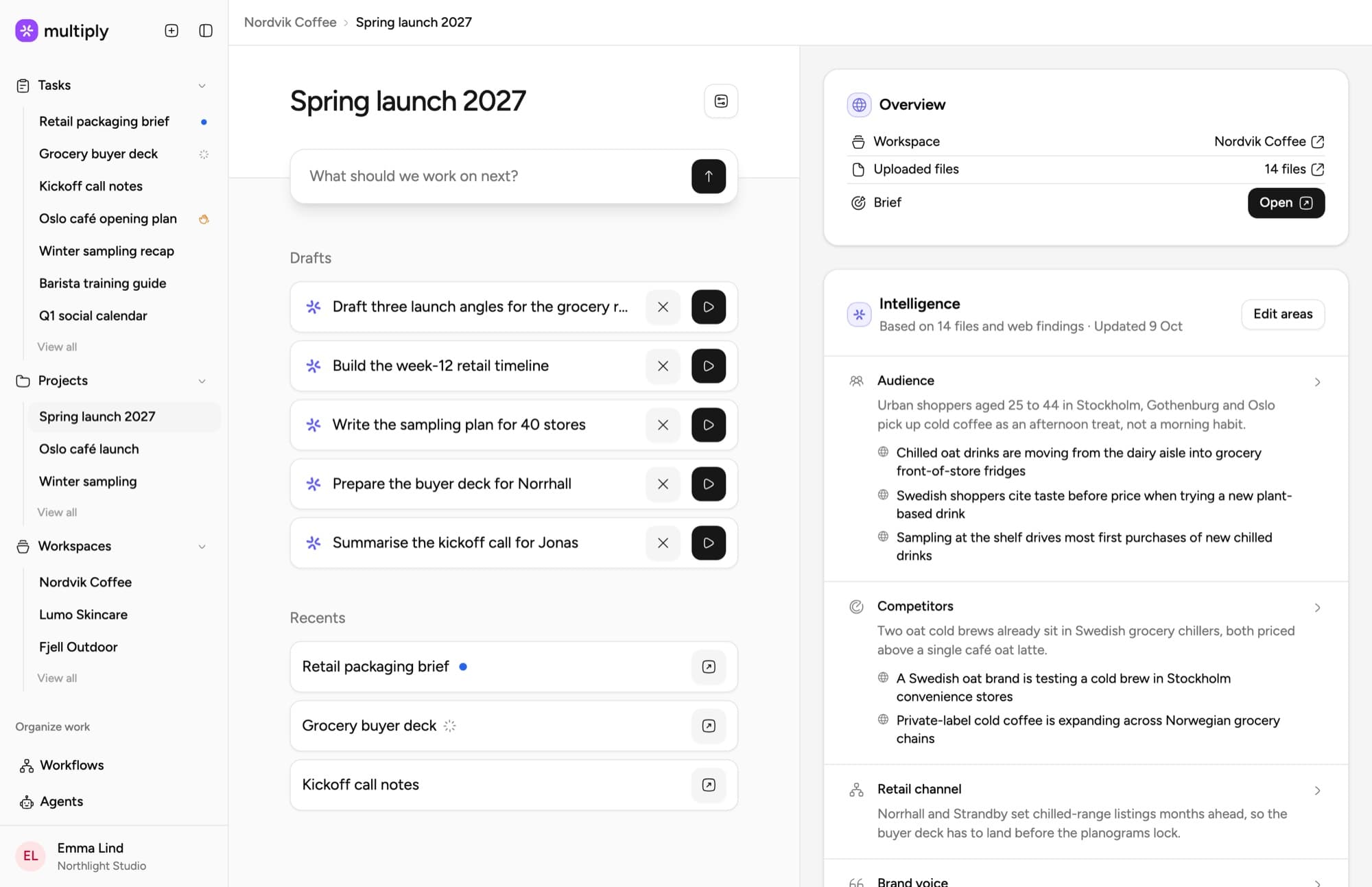
Side by side
Two rows say the same thing as each other: this is a scope difference, not a quality one. Both are agency-native and independent; the question is whether the slow part is getting to the idea or running everything around it.
| Springboards | Multiply | |
|---|---|---|
| Built for agencies | YesYes — by ex-agency strategists | Yes |
| Where it sits in the process | PartlyIdeation-weighted, front of the process | YesResearch through briefing, delivery and after |
| Client workspaces | Partly | YesArchitecture — org, workspace, project, task |
| Custom agents the agency owns | Partly | YesYes, centralised so improvements propagate |
| Runs on a schedule | NoNot its shape | YesWorkflows, plus weekly brief proposals per workspace |
| Independence | Yes | Yes |
Where it actually shows up in agency work
Feature grids tend to agree with each other. These are the places the categories genuinely diverge.
Ideation versus the whole arc
Springboards is weighted towards the front of the process. Multiply covers research, briefing, delivery and the recurring work afterwards, on the view that the expensive problem is the operation around the ideas rather than the ideas themselves.
Multi-client operations
Client workspaces with inherited context, held apart from each other, is architecture rather than a feature. If you run twenty clients, that is the difference between a tool people use and an operation the agency runs.
Agents the agency builds and owns
Custom agents matched to your process, centralised so an improvement propagates. The frameworks worth keeping are usually why a client hired the agency; a platform that standardises them away wins on tidiness and loses the thing being sold.
Work that runs without being asked
Scheduled workflows and a weekly job per workspace that drafts pitch proposals. Proactive rather than reactive is a different product shape, not a bigger feature list.
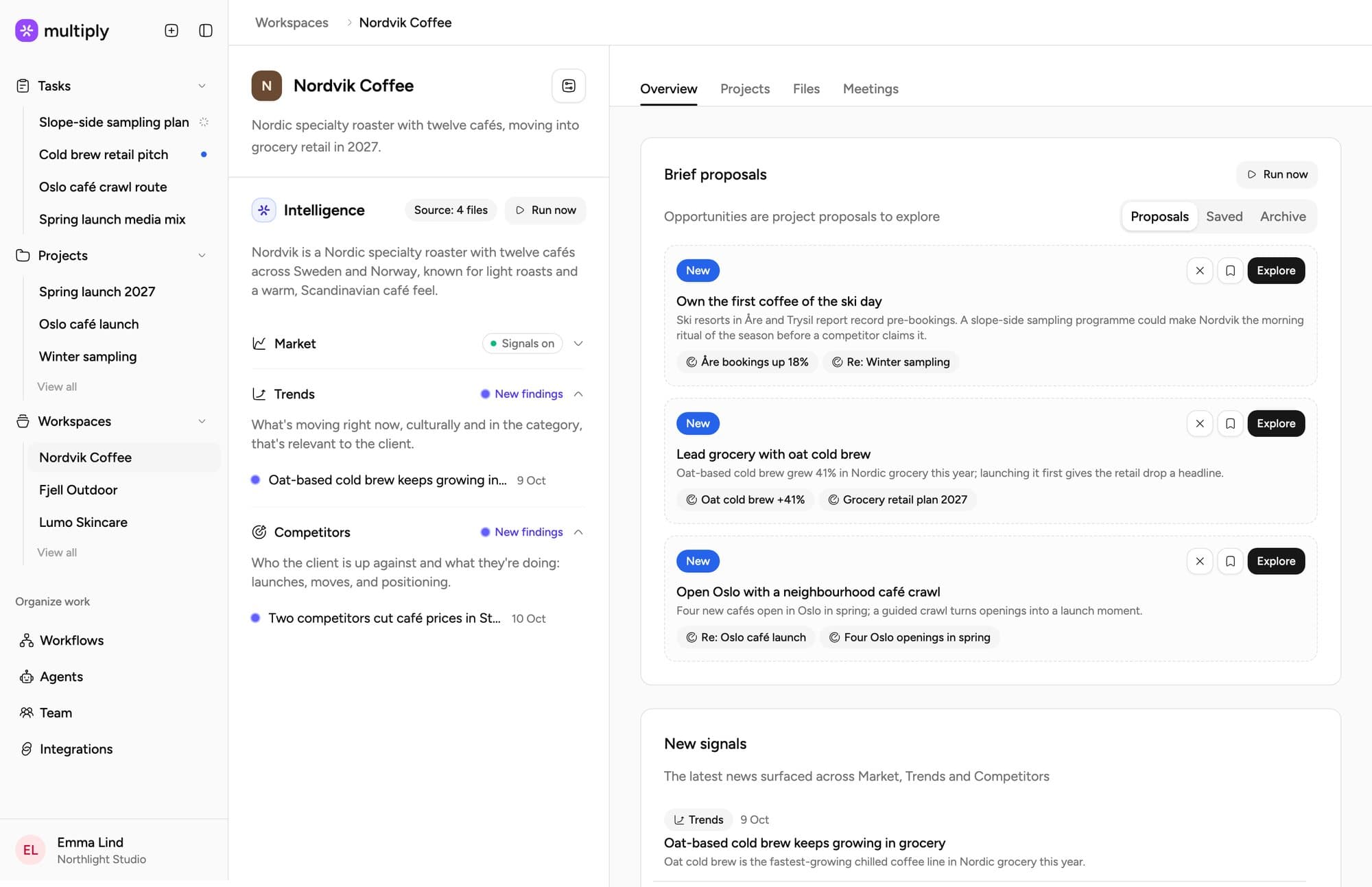
Own the first coffee of the ski day.
Nordvik's winter sales peak a month before its campaigns start. Three resorts have opened tenders for café partners.
When to choose Springboards
If the honest answer to "what is slow" is that the agency struggles to get to a distinctive idea, and the operational side is under control, Springboards is built for that and we are not. Buying an operating system to fix an ideation problem is an expensive way to be disappointed.
The two also overlap less than the category labels suggest, and some agencies run both. Worth being specific about which problem you are solving before either trial.
If you are mapping the category
The buyer's guide groups both under agency-native platforms and compares them against the other five categories. The Waldo comparison covers the other tool in that group.
Common questions
Bring one live account and one clear question. We will tell you if the answer is the other tool.
They are the two closest to each other positionally, yes — both agency-native rather than general-purpose. The difference is scope: ideation-weighted versus research through delivery with multi-client operations underneath.
For getting to a distinctive idea, take Springboards seriously. For assembling the picture a strategy is built on and having it still be there next quarter, that is what we build.
On one live account, with the same brief, and with a specific question decided in advance — either "did we get to a better idea" or "did the work around the idea get cheaper". They are different tests and running both at once produces a muddle.
Decide what is actually slow first
Bring a live account. If your bottleneck is ideation rather than operations, we will say so.