
A Jasper alternative for the work around the copy
Jasper is the most established of the content generation tools, built for marketing copy and brand-consistent output at volume. Agencies looking for an alternative have usually concluded that their problem is not producing copy — it is the research, briefing, client context and recurring work that surround it. A content tool covers the output; an agency operating system covers the process that decides what the output should be.
When the job really is copy at volume
If you are producing high volumes of on-brand marketing copy against a settled strategy, a content tool built for exactly that is the right purchase, and Jasper is the most mature of them. The reason agencies churn off it is not quality — it is that the expensive part of agency work happens before anyone writes anything, and a copy tool has no view of it.
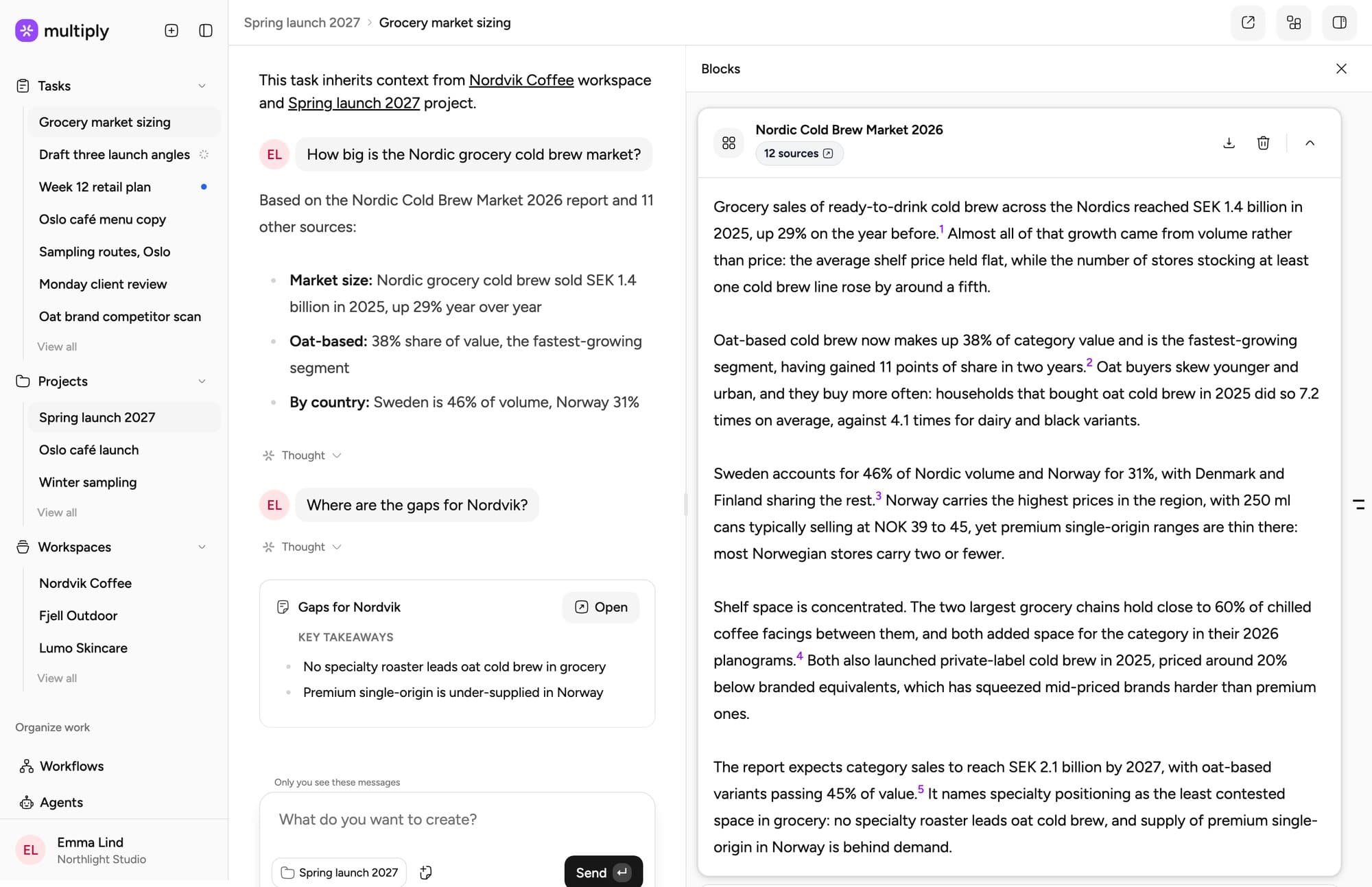
Side by side
The first row is a genuine point in Jasper’s favour, not a formality. If the job is volume of on-brand copy against a settled strategy, the left column wins and this page is telling you to stay.
| Jasper | Multiply | |
|---|---|---|
| Marketing copy at volume | YesWhat it is built for | NoNot its shape — a content tool does this better |
| Brand consistency | YesA setting, and a good one | YesComes from the client’s context on the workspace |
| Research and briefing | NoOutside its scope | YesWhere it starts |
| Non-writing agency jobs | No | YesProposals, coverage analysis, monitoring, reporting |
| Client workspaces | No | YesArchitecture |
| Compounds over time | No | YesYes — insights flow back to the client workspace |
Where it actually shows up in agency work
Feature grids tend to agree with each other. These are the places the categories genuinely diverge.
The process, not just the output
Research, briefing, strategy and delivery are the arc. Multiply is built across it; content tools start at the point where what to say has already been decided.
Everything that is not writing
Spokesperson matrices, coverage analysis, proposals, monitoring, reporting. Agency work is full of assembly jobs that are not copy, and they are where the non-billable hours go.
On-brand is not the same as differentiated
Consistency is table stakes. When every agency runs similar tools on similar data, the edge comes from context nobody else has — which is an accumulation problem, not a generation one.
Client context as architecture
Brand voice in a content tool is a setting. Here, a client’s brand, history and constraints sit on their workspace and steer every project — alongside the research and prior work that make the output specific rather than merely on-brand.
Context flows downLearnings flow back up
Your agency
- Who you areAgency profile
- House rulesBritish English · lead with the insight
- Your team12 people, every agent
Nordvik Coffee
- BrandGuidelines, tone, assets
- Audience and marketUpdated from 14 sources
- CompetitorsWatched weekly
- Client newsLive
- Calls6 recorded, all searchable
- Brief proposals3 this week
Spring launch 2027
- BriefApproved by Jonas
- PlanWeek 12 retail drop
- FilesKey visuals, research
Draft three launch angles
- Reads everything aboveHouse rules, the Nordvik brand and market, the spring brief
- SharedEmma, Leo and the Planner work from the same picture
When to stay on Jasper
Volume of on-brand copy against a settled strategy: stay. That is what it is for, and an operating system will not write your social calendar faster. The switch makes sense when the bottleneck has moved upstream — when the hard part is knowing what to write and being able to defend it.
And as with the rest of these, both is possible. A content tool at the output end and a platform holding the client context is a coherent stack.
Related reading
The buyer's guide puts content generation tools next to the other five categories, and briefs and strategy covers the upstream work directly.
Common questions
Bring a job that is not copy — a proposal, a coverage analysis, a monitoring brief.
It produces written work — briefs, analysis, proposals, reports, thought leadership — grounded in the project’s material and exported with sources. It is not built as a high-volume copy engine, and if that is the job a content tool does it better. The product pages are specific about what each part does.
Usually because the bottleneck was upstream of writing. If the slow part was assembling context, deciding the angle, or the recurring work nobody had time for, a copy tool never had a way to help — and the volume of copy was never the constraint.
Client brand material sits on the workspace and steers everything beneath it, so consistency comes from the context rather than from a style setting. The more interesting question is whether the work is specific to that client, which is what accumulated context buys.
Bring a job that is not writing
That is where the difference between a content tool and an operating system is obvious.