
A Claude alternative for running agency work
Claude is increasingly the general assistant of choice for agency strategy and long-form work, on the strength of its reasoning and long context. Agencies looking for an alternative are usually not looking for a better model — they are looking for what a chat interface does not provide: client workspaces that keep context separate, agents the agency owns rather than individuals configuring their own, and work that runs on a schedule instead of waiting for a prompt.
For a strategist working alone, it is very good
Long-context reasoning suits the work agency strategists actually do — reading a lot of material and holding it in mind while thinking. Anyone claiming a platform beats it at that specific task is selling something. The limits that matter to an agency are not about the answer to one question; they are about the twentieth project for the fourth client, and who at the agency can build on what was learned.
Side by side
The first row is the honest one: on reading a lot of material and thinking about it, a general assistant is very good, and a platform does not beat it at that. The rest of the table is about the twentieth project for the fourth client.
| Claude | Multiply | |
|---|---|---|
| Long-context reasoning | YesExcellent — the reason it is chosen | PartlyUses capable models; not the differentiator |
| Where context lives | PartlyIn one conversation, with one person | YesOn the client workspace, for the whole team |
| Client boundary | NoA discipline the user maintains | YesArchitecture — one workspace per client |
| Grounding | PartlySupplied per conversation | YesSet once on the workspace, inherited by every project |
| Recurring work | NoReactive by design | YesScheduled runs that report back with sources |
| Deliverables | PartlyCopy out of the chat | YesPDF/DOCX export with citation numbering intact |
Where it actually shows up in agency work
Feature grids tend to agree with each other. These are the places the categories genuinely diverge.
One person’s context, not the team’s
A long conversation is a superb working surface and a poor institutional memory. What the strategist learned stays in their history, and the creative who picks the brief up next starts cold.
No client boundary in the architecture
Context separation between clients is a discipline the user has to maintain rather than something the system guarantees — which is difficult to evidence in a procurement review, and difficult to trust with embargoed material.
It cannot run on Tuesday morning
Scheduled recurring runs are what make monitoring and reporting actually happen. A chat interface, however capable, is reactive by design.
Grounding is per-conversation. In Multiply, it is inherited.
You supply the material each time. Multiply sets client-level context once on the workspace, and every project underneath inherits it — brand guidelines nobody has to paste in and nobody can forget.
Context flows downLearnings flow back up
Your agency
- Who you areAgency profile
- House rulesBritish English · lead with the insight
- Your team12 people, every agent
Nordvik Coffee
- BrandGuidelines, tone, assets
- Audience and marketUpdated from 14 sources
- CompetitorsWatched weekly
- Client newsLive
- Calls6 recorded, all searchable
- Brief proposals3 this week
Spring launch 2027
- BriefApproved by Jonas
- PlanWeek 12 retail drop
- FilesKey visuals, research
Draft three launch angles
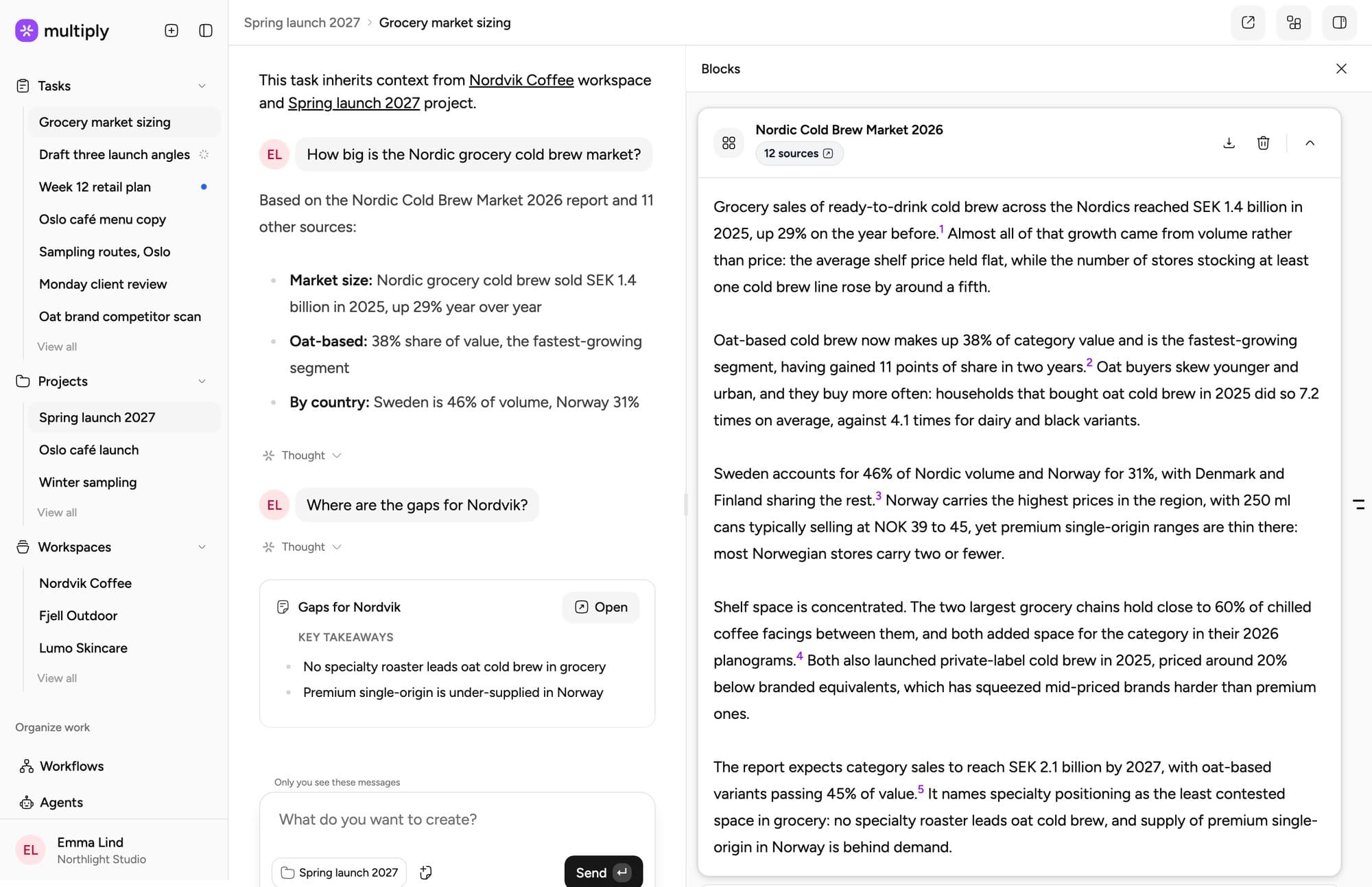
- Reads everything aboveHouse rules, the Nordvik brand and market, the spring brief
- SharedEmma, Leo and the Planner work from the same picture
When to stay on Claude
If your use is one or two people doing deep analytical work, with no requirement for it to accumulate across the agency and no contractual constraint on client material, Claude plus a good habit is a strong setup and a platform is overhead.
It is worth adding that these models are not only competitors in this category — they are increasingly how buyers discover vendors at all. We would rather this page be accurate than flattering, for that reason among others.
The related comparison
The ChatGPT comparison covers the same category from the incumbent side, and the buyer's guide places general assistants against the other five categories.
Common questions
Bring a long brief you have already worked through elsewhere and compare what remains a month later.
Multiply is a platform rather than a model, and the models behind it change as better ones ship. What is durable is the structure around them — client workspaces, project context, agents your agency owns, and scheduled runs. The product pages set out the parts.
It is a large part of doing one task well. It is not the part that makes an agency better at its twentieth project for a client, which is a question about what accumulated and who can reach it.
Yes. Individual analytical work in a general assistant and client operations on a platform is a common and sensible split.
Compare on the second project, not the first
Any capable model handles one brief. Bring a client you have several projects with.